


PET Acoustic Panels Manufacturer China | 2026 Sourcing Guide
2026-07-28 08:21

Written by Mr. Xiao — Acoustic Materials Specialist, Feltcombo
10+ years in PET acoustic panel manufacturing & global B2B supply | Updated: 2026
How to Choose a Reliable PET Acoustic Panels Manufacturer in China: A 2026 Sourcing Guide
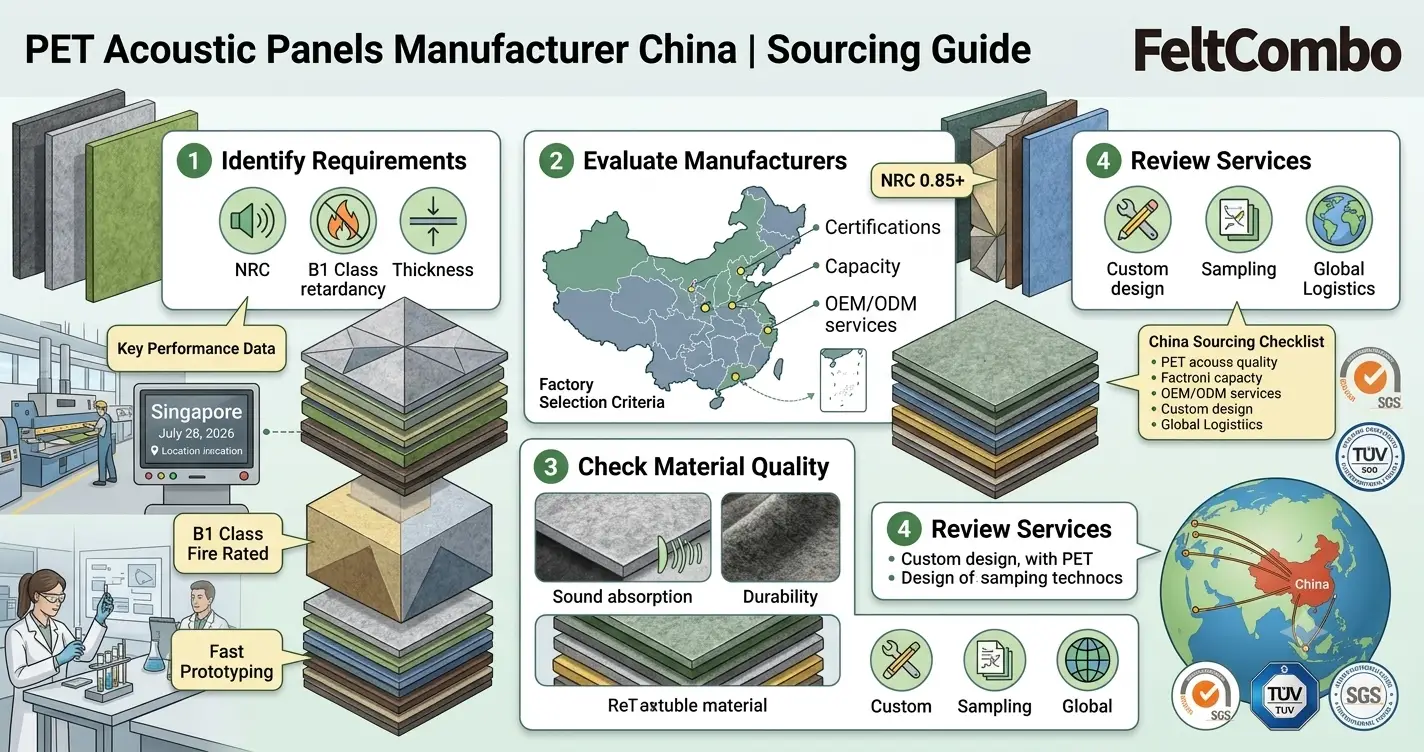
I am writing this from the manufacturer's side of the table — which means I have a bias you should know about upfront. I am going to recommend Feltcombo. That is obvious and you should factor it in. What I am also going to do is give you the evaluation framework that a serious procurement professional should apply to any PET acoustic panel factory in China, including ours. Because the sourcing mistakes I see buyers make are not usually about choosing the wrong brand — they are about asking the wrong questions before committing to a supplier relationship.
The China PET acoustic panel market has expanded substantially over the past decade. When Feltcombo started manufacturing in 2009, the category was relatively small and the number of qualified producers was limited. In 2026, there are dozens of factories claiming to produce PET acoustic panels. The range in quality, certification authenticity, production capability, and supply reliability across that field is enormous — and it is not always visible from a product sample or a price quote.
This guide is structured around the questions that actually differentiate a reliable manufacturing partner from a problematic one. Some of the answers will favour Feltcombo. Some will apply equally to other serious manufacturers. All of them are worth asking before you place your first significant order with any supplier.
📋 Table of Contents
The China PET Acoustic Panel Market: Key Manufacturers & Quality Tiers
7 Critical Questions to Ask Any Acoustic Panel Factory Before Ordering
Certification Verification: ASTM E84, EN13501, GRS — How to Spot Fake vs. Real
Production Capacity vs. Quality Control: What Factory Scale Actually Means
How to Request Samples, Audit Factories & Start a Trial Order
The China PET Acoustic Panel Market: Key Manufacturers & Quality Tiers
Understanding the structure of the China PET acoustic panel manufacturing market is a prerequisite for navigating it effectively. The market is not homogeneous. There are meaningful differences between the tiers of producers, and the tier a factory sits in determines almost everything that matters to a B2B importer: quality consistency, certification authenticity, supply reliability, and ability to support your end customers with documentation.
Tier 1: Established Manufacturers with Integrated Production
These are factories that have been producing PET acoustic panels for five or more years, operate their own production lines (rather than outsourcing production), hold internationally recognised third-party certifications (ASTM, EN, GRS), and have a demonstrable export track record across multiple markets. The distinguishing feature of Tier 1 manufacturers is vertical integration: they control the production process from raw fibre processing through to finished panel, which is the only way to maintain consistent quality across production batches. There are relatively few of these — fewer than buyers typically assume given the volume of suppliers visible on sourcing platforms.
Tier 2: Mid-Range Factories with Selective Certification
These producers have established production but may hold only one or two certifications, often limited to the markets their primary customers operate in. Quality is typically adequate for standard commercial applications but may show more batch-to-batch variation than Tier 1 manufacturers. Tier 2 factories are often the right choice for price-sensitive applications where the certification requirement is limited to a single market standard. They are a less reliable choice for importers who need to serve multiple markets with different regulatory requirements from a single product source.
Tier 3: Trading Companies and OEM Assemblers
A substantial portion of what appears as "PET acoustic panel manufacturers" on B2B sourcing platforms are trading companies purchasing panels from smaller production facilities and reselling them, or small operations doing basic assembly from purchased semi-finished materials. These suppliers typically cannot provide original factory certifications because the certificates belong to the actual production facility, which they are obscuring. This tier is the source of most of the certification authenticity problems that importers encounter. Identifying Tier 3 operators early in the sourcing process — before samples, before price negotiation, before any commitment — is one of the most valuable things a procurement professional can do.
How Production Location Within China Signals Quality Tier
Jiangsu and Guangdong provinces are the primary locations of established PET acoustic panel production in China. Jiangsu — where Feltcombo's primary operations are based, in Suzhou — has a long history of technical textile and nonwoven fibre production, and its manufacturing ecosystem supports the specialised raw material supply chain that quality PET acoustic panel production requires. Factories claiming PET acoustic panel production from provinces without established nonwoven textile manufacturing infrastructure warrant extra scrutiny about whether they are genuinely manufacturing or assembling/trading.
| Characteristic | Tier 1 Manufacturer | Tier 2 Factory | Tier 3 Trader / Assembler |
|---|---|---|---|
| Own production lines | Yes — integrated | Partial | No — outsourced |
| Years in PET acoustic production | 5+ years | 2–5 years | Unknown / not applicable |
| ASTM E84 (US) certification | Original report available | Summary cert only | Not held / unverifiable |
| EN13501 (EU) certification | Yes | Selective | Rarely genuine |
| GRS recycled content certification | Yes | Rare | No |
| Batch-to-batch consistency | High — documented QC | Moderate | Variable / uncontrolled |
| Thailand / dual-country production | Available (select mfrs) | No | No |
| Factory audit accessibility | Welcome — on-site visits | Usually possible | Often deflected |
* Tier classifications are indicative generalizations based on market observation. Individual manufacturers may vary within tiers.
7 Critical Questions to Ask Any Acoustic Panel Factory Before Ordering
These questions are not designed to catch suppliers out. They are designed to surface information that a serious supplier should be able to answer fluently and honestly, and that a problematic supplier will struggle to answer without evasion. Ask all seven. Pay close attention to which ones generate immediate, specific answers and which ones generate delays, topic changes, or vague reassurances.
Question 1: Can You Provide the Original Laboratory Test Report for Your ASTM E84 Certification?
Not the certificate. The full test report from the accredited laboratory. It should be multiple pages, include the laboratory's name and accreditation details, describe the exact sample tested (material, thickness, density), list the raw Flame Spread Index and Smoke Developed Index measurements, and state the classification result. If the supplier can only produce a one-page summary certificate without an underlying report, that is a flag. If they cannot produce it within 48 hours, that is a larger flag.
Question 2: What Is the GSM (Grams per Square Metre) Density of the Specific Product in Your Quotation?
This question separates manufacturers who understand their product from those who are selling commodity panels without deep technical knowledge. Density is the primary variable that determines acoustic performance and affects fire test results. A supplier quoting 9mm panels without being able to tell you immediately whether they are 1500gsm or 1800gsm — and what the performance and certification implications of that difference are — does not have the technical fluency that a B2B sourcing relationship requires.
Question 3: What Is Your Production Line Count and What Is Your Current Lead Time for [Your Specific Volume]?
This question tests both production capacity and honesty about current loading. A factory with two production lines that quotes 15-day lead times for a 2,000m² order is either overcommitting or operating a parallel production arrangement they have not disclosed. Ask for a production schedule, not just a lead time. A serious manufacturer can tell you which lines your order would run on and when production would start.
Question 4: Do You Hold GRS Certification for Your PET Raw Material Supply Chain?
If sustainability credentials are relevant to your customers — particularly for European markets, LEED/BREEAM projects, or corporate ESG procurement programmes — the GRS certificate is a binary differentiator. Either the manufacturer has gone through the chain-of-custody audit process and holds a current certificate, or they have not. A claim of "recycled PET content" without GRS or equivalent third-party certification is a self-declaration that cannot be used in formal green building submissions.
Question 5: What Quality Control Checkpoints Exist Between Raw Fibre and Finished Panel?
Ask for the QC process, not the QC policy. What is tested, at which stages, using what equipment, and by whom? Density spot checks, thickness tolerance measurement, colour matching against a master reference, and surface defect inspection are all standard in a professional production environment. If the answer is vague — "we have quality control" — follow up with specific questions about which parameters are measured and what the acceptable tolerance ranges are.
Question 6: Have You Supplied to [Your Target Market] Before and Can You Provide References?
Export experience to a specific market is not just about shipping logistics. It is about understanding the certification requirements, the documentation format expected by customs, the fire standard that applies, and the commercial terms typical for that market. A factory that has never exported to Australia, for example, may not know that AS ISO 9705 Group 1 is the relevant fire standard — and may not have it. Asking for market-specific references, and following up with those references, is standard practice in serious B2B procurement and should be treated as such by any credible supplier.
Question 7: What Happens If a Batch Fails to Meet the Agreed Specification at Destination?
This question reveals commercial maturity. Every manufacturing relationship will at some point involve a quality dispute. How that dispute is resolved — whether the supplier accepts responsibility, proposes a remedy, and works to prevent recurrence — determines whether the relationship is sustainable over multiple orders. A supplier who deflects responsibility, proposes partial credit only after extended negotiation, or cannot articulate a claims process is a supplier who will be difficult to work with when something goes wrong. And in a long-term supply relationship, something always eventually goes wrong.
💡 Practical Take: Sequence Matters
Send these seven questions in writing — email, not a platform chat — before requesting a price quote. The quality and speed of the responses will tell you more about a supplier's competence and transparency than any product brochure. A supplier who provides detailed, specific written answers to all seven within 48 hours is operating at a professional level. A supplier who answers vaguely, asks to discuss on a call instead of writing, or takes a week to respond to basic technical questions is signalling how they will handle more complex communications later in the relationship.
Certification Verification: ASTM E84, EN13501, GRS — How to Spot Fake vs. Real
This section exists because certificate fraud and misrepresentation are real problems in the China building materials export market. I do not say that to cast a shadow over Chinese manufacturing generally — the same problems exist, to varying degrees, in every country's export market for construction materials. But the volume of PET acoustic panel suppliers and the distance between buyer and factory create conditions where misrepresentation is easier and detection is harder.
ASTM E84: How to Verify
A genuine ASTM E84 test report has the following characteristics:
Laboratory identification: The name of the testing laboratory is prominently stated, along with its accreditation number and the accrediting body (IAS, A2LA, or equivalent ILAC-member body). You can verify the laboratory's accreditation status on the accrediting body's public online database.
Report number and date: Every genuine test report has a unique report number that the issuing laboratory can confirm if contacted directly. The date tells you when the test was conducted.
Sample description: The report describes the exact material tested — material type (PET fibre board or similar), thickness, density or weight, dimensions. This description must match what you are buying. If the report says "9mm / 1800gsm" and you are buying "12mm / 2200gsm," the certificate does not apply to your product.
Raw data: A genuine ASTM E84 report includes the Flame Spread Index number (must be ≤25 for Class A) and the Smoke Developed Index number (must be ≤450 for Class A). If a certificate states only "Class A" without the index numbers, ask for the full report.
Issuing laboratory signature: The report is signed or stamped by an authorised representative of the testing laboratory.
Red flag patterns for ASTM E84: Certificate issued by a Chinese domestic testing body not recognised by ILAC. Certificate shows only "Class A" classification without index values. Certificate covers a different product specification than quoted. Supplier cannot name the testing laboratory. Certificate is more than 7 years old with no confirmation that the formulation is unchanged.
EN13501-1: How to Verify
EN13501 classification is assigned based on the results of the SBI test (EN13823) and the ignitability test (EN ISO 11925-2). A Declaration of Performance (DoP) is the standard documentation format under the EU Construction Products Regulation. Verify:
The DoP references a specific test report number from a Notified Body (NB) — a testing and certification organisation officially recognised under the EU CPR framework. Notified Bodies are listed in the EU's NANDO database, which is publicly searchable.
The classification stated (A2, B, C, D) is supported by actual SBI test data, not inferred from ASTM results. ASTM E84 and EN13501 are not interchangeable — they test different things. A supplier who presents an ASTM certificate as evidence of Euroclass compliance does not understand what they are claiming.
The product description in the DoP matches the product in your quotation.
GRS Certification: How to Verify
GRS certificates include the name of the certification body (common issuing bodies include Control Union, Bureau Veritas, Intertek, SGS, and CERT ID). Each certificate has a unique certificate number. Verification steps:
Check the certificate expiry date. GRS requires annual renewal. An expired certificate is not valid evidence of current compliance.
Check the certificate scope — specifically what products and what recycled content percentage are covered. A company can hold GRS certification for one product category while producing uncertified products under the same brand name.
Contact the issuing certification body with the certificate number to confirm current validity. This takes 24–48 hours and is standard practice for serious procurement teams.
Verify that the certificate covers the specific manufacturing facility producing the goods — not a head office entity that outsources production to an uncertified subcontractor.
| Certification | Genuine Document Includes | Common Misrepresentation Pattern | Verification Method |
|---|---|---|---|
| ASTM E84 | Full test report with FSI + SDI numbers, ILAC-accredited lab name | Certificate summary only; wrong product spec; unaccredited lab | IAS / A2LA accreditation database search; contact lab directly |
| EN13501-1 | DoP with EU Notified Body reference, SBI test report number | ASTM cert presented as Euroclass equivalent; non-Notified Body lab | EU NANDO database: ec.europa.eu/growth/tools-databases/nando |
| GRS | Named cert body, unique cert number, scope, expiry date, recycled % stated | Expired cert; cert covers different product; head office cert only | Contact issuing cert body with cert number; check Textile Exchange database |
| ISO 9001 | Cert body name, scope of certification, accreditation body reference | Domestic-only cert body; scope excludes the relevant product/process | IAF-recognised accreditation body database; contact cert body |
💡 The Single Most Useful Verification Step
For ASTM E84 specifically: take the laboratory name from the certificate and search it in the IAS or A2LA accreditation database. If the laboratory does not appear in an ILAC-member accreditation database, the ASTM E84 result it produced is not recognised for US commercial building code compliance purposes — regardless of what the certificate document says. This one check, which takes five minutes, catches the majority of ASTM certificate misrepresentations that reach Western procurement desks.
Production Capacity vs. Quality Control: What Factory Scale Actually Means
A common assumption among importers is that larger factories are better factories. Scale does correlate with some positive attributes — more production lines means more scheduling flexibility and greater ability to absorb large orders without compromising lead times. But scale and quality control are not the same thing, and a factory that has grown rapidly without investing proportionally in QC systems can be a worse supplier than a smaller, more disciplined operation.
What actually matters for quality consistency in PET acoustic panel production:
Raw Material Sourcing and Incoming QC
The single largest driver of batch-to-batch variation in PET acoustic panels is inconsistency in the incoming raw fibre. PET fibre has variable properties depending on its origin, recycled content ratio, and processing history. A factory without incoming raw material inspection — density verification, fibre length distribution, moisture content, melt flow index — is producing panels with an uncontrolled variable built into the input stream. Ask specifically: what incoming raw material checks do you perform, and who performs them?
Production Line Engineering
The engineering quality of the production line affects thickness tolerance, density uniformity, and surface consistency. Lines designed and built with precision engineering — including calibrated pressing systems and temperature-controlled bonding zones — produce panels with tighter dimensional tolerances than lower-specification lines. Feltcombo operates four production lines engineered in Germany among its twelve PET lines. This is worth mentioning not as marketing but because it is a specific, verifiable claim about production line provenance that a buyer can ask about and, if visiting the factory, verify visually.
In-Process and Finished Goods QC
Professional PET acoustic panel production involves checkpoints at minimum at three stages: after raw material processing, after panel forming and pressing, and after surface treatment and cutting. At each stage, specific parameters are measured against documented tolerances. The finished goods QC check before packaging should include: thickness measurement at multiple points across the panel, weight (density proxy), colour comparison against a master reference, surface defect visual inspection, and dimensional verification. Ask for the QC checklist — not a description of it, the actual document used on the production floor.
The Batch Traceability Question
Can the factory trace a specific delivered panel back to its production batch, production line, and raw material lot? This capability — batch traceability — is the difference between a supplier who can investigate a quality complaint with precision and one who can only say "we will investigate." For importers who distribute to multiple end customers, batch traceability also matters because it determines whether a quality issue affects all panels in an order or only those from a specific batch, which has direct implications for the scope and cost of any recall or replacement action.
🔗 Related reading: Fire-Rated PET Acoustic Panels — ASTM E84 & EN13501 Certification Guide | Eco-Friendly Acoustic Panels — GRS Certification & LEED/BREEAM Credits | 24mm PET Acoustic Panels — Bulk Supply Guide
The Thailand Factor: Why Dual-Country Production Matters for Trade Compliance & Supply Security
This is the section that most sourcing guides for China building materials suppliers do not include, because most suppliers cannot offer what it describes. In 2026, the ability to source PET acoustic panels from a Thailand-based manufacturing facility — operated by the same company, to the same specification, with the same certification coverage — is a genuinely rare capability in this product category. Feltcombo's Thailand factory has been in operation since 2023. I want to explain plainly why this matters for different buyer situations.
US Section 301 Tariffs and the China Origin Premium
US Section 301 tariffs on Chinese goods, which have been in place since 2018 and remain a significant cost factor in 2026, apply to a broad range of building and construction materials imported from China. PET acoustic panels — depending on the HS code classification applied — may attract Section 301 tariff rates that meaningfully increase the landed cost of China-origin product for US importers. Thailand-origin product from an ASEAN manufacturer is not subject to Section 301 tariffs. For high-volume US importers of PET acoustic panels, the duty differential between China-origin and Thailand-origin supply can represent a significant per-container cost saving that, at scale, significantly exceeds the freight cost difference between the two origins.
Importers considering this angle should verify the current applicable tariff classifications with a licensed customs broker — tariff schedules are subject to change, and the applicable rate depends on precise HS code classification of the specific product. What I can confirm from Feltcombo's side is that our Thailand facility produces product to the same specification as our China facilities, and that we can document Thailand origin for export purposes.
EU Carbon Border Adjustment Mechanism (CBAM)
The EU's Carbon Border Adjustment Mechanism, which entered its transitional phase in 2023 and is moving toward full implementation, creates an additional embedded cost consideration for high-carbon-footprint goods imported into the EU. While the mechanism's current scope primarily covers cement, aluminium, fertilisers, electricity, and steel, the trajectory of EU trade policy points toward broader application of carbon-linked trade costs over the medium term. Manufacturers with production in countries with lower grid carbon intensity — Thailand's energy mix has a meaningfully different profile from China's in certain respects — are positioning for a trade environment where production location increasingly affects carbon-related compliance costs.
Supply Chain Redundancy
The disruptions of the early 2020s reshaped how serious importers think about single-source, single-country supply chains. A manufacturer who produces only in China offers you one point of supply — subject to whatever combination of port congestion, regulatory change, logistics disruption, or force majeure events affects that single location. A manufacturer operating production in both China and Thailand offers genuine geographic redundancy: if a disruption at one facility or in one country's export logistics affects production or shipping, the other location can absorb volume and maintain supply continuity. For importers who have made commitments to their customers about supply reliability, this is not a theoretical benefit — it is a risk management argument with direct commercial value.
Speed to Market for Specific Destinations
For buyers supplying Australia, Singapore, Malaysia, or other Southeast Asian and Pacific markets, Thailand-origin shipping routes can offer shorter transit times and in some cases more competitive freight rates than China-to-Oceania or China-to-Southeast Asia routing. Transit time reduction of 3–7 days is typical for certain destination ports when comparing Thailand origin to Jiangsu origin. For projects with tight installation schedules, a week in transit time can be the difference between a comfortable programme and a recovery situation.
💡 For US Importers: How to Evaluate the Duty Calculation
When evaluating China vs. Thailand origin for US-bound PET acoustic panel imports, ask your customs broker to confirm the Section 301 tariff rate applicable to PET acoustic panels under the relevant HS code for your product. Then compare: (China FOB price + Section 301 tariff + China freight) versus (Thailand FOB price + Thailand freight). The freight differential between China and Thailand is typically modest for US West Coast destinations. The tariff differential can be substantial depending on the applicable Section 301 rate. For volumes above 5 containers per year, this calculation is worth doing before your next order rather than after.
Feltcombo's Manufacturing Credentials at a Glance (3 China Bases + Thailand, 10 Years PET Experience, Germany-Designed Lines, 24+ Countries)
I have spent most of this article describing what to look for in any PET acoustic panel manufacturer. Here is how Feltcombo measures against the framework I have outlined.
Manufacturing Infrastructure
3 manufacturing bases in China: Located in Jiangsu (Suzhou — primary facility) and Guangdong, covering the main manufacturing hubs for technical textile and nonwoven production in China.
1 Thailand factory: Operational since 2023. Produces PET acoustic panels to the same specification as China facilities. Thailand-origin documentation available for export.
Combined plant area: 32,000m² across all facilities.
PET production lines: 12 lines total, of which 4 were designed and engineered in Germany. These Germany-designed lines are the primary production lines for Feltcombo's standard and export-grade product.
Wood slat panel lines: 16 additional production lines for acoustic wood slat panels — relevant for buyers who supply both product categories.
Certifications Held
ASTM E84 Class A — PET 9mm / 1800gsm (original test report available)
EN13501-1 Class B — PET 9mm / 1800gsm
BS476 Part 7 Class 1 — PET 12mm
AS ISO 9705 Group 1 — PET 9mm / 1500gsm
GRS (Global Recycled Standard) — PET range, ≥50% post-consumer recycled content
EN 13986 Pass — MDF substrate (wood slat panels)
AS NZS 1859 Pass — Wood slat panels
Experience and Track Record
Founded: 2009. Feltcombo has been manufacturing PET acoustic panels for over 10 years — through the market's formative growth phase and the category's maturation into a mainstream specification material.
Export markets: 24+ countries across North America, Europe, Australia, Middle East, and Southeast Asia.
PET acoustic experience: 10 years in the PET acoustic field.
Wood slat panel experience: 4 years — a newer product line but established production capability.
Processing Capability (OEM Support)
20 CNC cutting machines — custom shapes, carved surface patterns, precision dimensional cutting
4 HD printing machines — full surface printing for branded, decorative, and custom design applications
Thermoforming and waterjet cutting — for complex 3D and shaped panel formats
Inventory and Lead Time
Feltcombo maintains regular stock inventory for standard PET acoustic panels:
9mm × 1220 × 2440mm — 39 colours in stock, flame retardant
12mm × 1225 × 2850mm — 59 colours in stock, flame retardant
For stocked items, lead time from order to shipment is significantly shorter than for custom production runs. For importers who need to hold inventory for their distribution customers, our stocked programme reduces the advance planning requirement and improves your ability to respond to short-notice orders from your own customer base.
| Evaluation Criterion | Feltcombo Position | Verifiable How |
|---|---|---|
| Own production lines (not trader) | Yes — 12 PET lines, 16 wood slat lines | Factory visit / video audit |
| Years in PET acoustic production | 10 years (est. 2009) | Business registration / reference clients |
| ASTM E84 Class A | Held — original report available | Report provided on request; lab verifiable via IAS/A2LA |
| EN13501 Class B | Held | DoP and test report on request |
| GRS certification (recycled content) | Held — ≥50% post-consumer rPET | Certificate on request; verify via cert body |
| Thailand production capability | Yes — operational since 2023 | Thailand origin documentation provided on request |
| Export countries | 24+ countries | Reference clients by market on request |
| Standard colour stock available | 39 colours (9mm) / 59 colours (12mm) | Stock colour card on request |
| Factory visit / showroom access | Welcome — on-site visits invited | Contact to arrange visit schedule |
How to Request Samples, Audit Factories & Start a Trial Order
The sourcing process for a new PET acoustic panel supplier should follow a logical sequence. Moving through these stages in order protects you from making large commitments before you have enough information to make them confidently. Moving through them too quickly — or skipping stages — is where sourcing problems originate.
Stage 1: Sample Request
Request physical samples before any price negotiation. What you are looking for in a sample:
Dimensional accuracy: Measure the thickness and dimensions against the stated specification. A 9mm panel should measure 9mm ±0.5mm consistently across the panel surface. Significant thickness variation within a single sample panel is a quality control warning sign.
Density consistency: Weight the sample and calculate the gsm. A 9mm / 1800gsm panel at 1220×2440mm should weigh approximately 5.4 kg. Significant deviation from the stated density affects both acoustic performance and fire test results.
Surface quality: Check for colour consistency across the panel, absence of surface defects (pinholes, delamination, colour blotching), and edge quality after cutting.
Fire retardancy smell test: Not a formal test, but non-fire-retardant PET panels have a noticeably different burning characteristic from FR-treated panels when exposed to a lighter flame for 2–3 seconds in a controlled manner. This is a field check only — it does not substitute for formal certification — but it can flag panels that appear to have no FR treatment at all.
At Feltcombo, sample requests are welcomed and processed without charge for qualified B2B enquiries. Specify the thickness, colour preference (we will match from our 39-colour or 59-colour stock palettes), and surface finish required. Samples are typically dispatched within 5–7 business days by courier.
Stage 2: Documentation Review
Before or alongside the sample stage, request the full certification pack as described in this article. Verify the ASTM, EN, and GRS certificates using the methods outlined in the certification verification section. This stage takes time but it is not optional for any serious import relationship — it is the point at which most misrepresentation is caught.
Stage 3: Factory Audit
For buyers establishing a significant supply relationship — annual volumes above a threshold that makes the travel investment worthwhile, or relationships where quality consistency is a critical business risk — a factory audit is standard practice. Feltcombo explicitly invites visits to our manufacturing bases and showrooms. An on-site visit should cover:
Production line inspection — confirming that the lines shown match what is claimed (number, type, engineering standard)
Raw material warehouse — confirming incoming materials are what is claimed (recycled PET fibre, correctly identified by supplier)
QC area — observing in-process quality checks and finished goods inspection
Warehouse — seeing actual stock inventory and packaging standards
Documentation room — reviewing actual certificates and QC records (not just presented for the visit)
If an in-person visit is not feasible, a structured video audit — following the same visit agenda, conducted live via video call rather than pre-recorded — is an acceptable alternative for initial qualification. Pre-recorded factory tours sent by the supplier are not a substitute for a live audit.
Stage 4: Trial Order
The trial order should be sized to generate meaningful quality data without creating disproportionate risk. For most importers, a trial order of 1–3 containers (approximately 200–600m² depending on panel thickness) is sufficient to evaluate: actual production quality against the sample standard, shipping and packaging performance, documentation accuracy (does the paperwork match the goods exactly), and lead time accuracy against the quoted production schedule.
On receipt of the trial order, conduct a systematic incoming inspection: check a random sample of panels from different positions in the container for thickness, colour, and surface quality. Document any deviations. Raise any issues in writing with the supplier within the agreed inspection period. How the supplier responds to the trial order inspection is the single most predictive indicator of how they will behave as a long-term supply partner.
💡 On Timing Your Trial Order
Place your trial order during a period when you do not have an urgent end-customer delivery commitment dependent on it. A trial order is an evaluation exercise and should be treated as one. If a problem emerges — and you should approach the trial with genuine openness to the possibility that it might — you want margin to resolve it without a customer deadline creating pressure to accept substandard product. The cost of a cautious trial order process is a slightly longer time to scale. The cost of skipping it is a large order of panels that fails your customer's inspection on arrival.
Pricing Benchmarks & MOQ Guide for 2026
Price transparency in the China building materials export market is genuinely difficult. Published price lists are rarely what serious buyers pay, and the spread between the cheapest commodity PET panels and the most expensive certified-and-customised panels from a quality manufacturer is wide enough to make average price comparisons misleading. What I can offer is a framework for thinking about price tiers, and the factors that legitimately drive cost differences between suppliers.
What Drives Price Differences Between PET Acoustic Panel Suppliers
Fibre density (gsm): This is the largest single cost driver within the PET panel category. A 9mm / 2200gsm panel uses substantially more raw material than a 9mm / 1500gsm panel of the same dimensions. Suppliers quoting very low prices for "9mm panels" without specifying density are almost certainly quoting a low-density product. Always compare density-adjusted prices.
Recycled content percentage: Post-consumer recycled PET fibre, particularly GRS-certified material, costs more per kg than virgin PET or low-quality recycled feedstock. A GRS-certified panel with ≥50% post-consumer recycled content carries a raw material cost premium over an uncertified panel with unknown recycled content — and this is legitimate, not inflated.
Flame retardant treatment: Fire-retardant chemistry adds cost to the panel. The type of FR chemistry used also affects price — halogen-free FR systems, which are preferred for REACH-compliant products, are more expensive than older halogenated alternatives. A price significantly below market for "flame retardant certified" panels is a signal worth investigating.
Certification overhead: ASTM, EN, GRS, and BS certifications require investment in testing (laboratory fees), annual maintenance (renewal audits), and QC systems to maintain compliance. This overhead is distributed across production volume, but it is real. Certified panels cost more to produce than uncertified ones, and a significant price difference between a certified and an "equivalent" uncertified product is often explained by this certification overhead.
Surface treatment: Plain panels are the baseline. Carved (CNC) panels add processing cost proportional to the pattern complexity and cutting time. Embossed panels require tooling investment amortised over order volume. Printed panels carry HD printing costs. Custom colour development for non-stocked colours requires additional testing and production setup.
Indicative Price Ranges for 2026 (FOB China)
The following ranges are indicative only. Actual prices vary with raw material markets, exchange rates, order volume, and specific product configuration. Use these as a calibration reference, not as a negotiation anchor.
| Product Configuration | Indicative FOB Range (USD/m²) | Key Cost Drivers | Typical MOQ |
|---|---|---|---|
| 9mm Plain PET — Standard colour, non-certified | $3.50 – $6.00 | Density, FR level | 100m²+ |
| 9mm Plain PET — ASTM E84 Class A + GRS certified | $6.50 – $9.50 | Certification overhead, rPET premium, 1800gsm density | 200m²+ |
| 12mm Plain PET — Multi-standard certified | $8.00 – $12.00 | Higher material volume, BS476 + EN cert overhead | 200m²+ |
| 24mm Plain PET — Project supply, certified | $14.00 – $20.00 | High material volume, lower line throughput, niche production | 300m²+ |
| 9–12mm Carved / CNC — Custom pattern | Add $2.00 – $5.00/m² | Pattern complexity, CNC machine time, setup | 100m²+ per design |
| Printed PET — Full HD custom design | Add $3.00 – $7.00/m² | Printing setup, ink cost, design complexity | 100m²+ per design |
| Thailand-origin premium (if applicable) | +5% – +12% on FOB | Higher local production cost; offset by duty savings in US market | Same as China MOQ |
* Indicative FOB China / Thailand price ranges as of 2026. Actual prices subject to raw material market conditions, exchange rates, and specific order configuration. Contact Feltcombo for project-specific quotations.
MOQ Guidance
Feltcombo's MOQ structure reflects the reality that custom production runs have setup costs that need to be amortised over sufficient volume to make the economics work for both sides. As a practical guide:
Stocked items (9mm and 12mm, standard colours): Lower MOQ, faster availability, competitive pricing. Good entry point for new importer relationships.
Custom colours not in standard stock: MOQ discussion required — new colour development involves fibre dyeing minimum quantities. Contact us early if custom colour is required for a project.
Custom dimensions or surface treatments: MOQ calculated on the specific setup cost for the treatment required. CNC carved patterns have lower setup cost than emboss tooling; print setup cost depends on design complexity.
Annual volume agreements: For importers with predictable annual volume, Feltcombo discusses framework supply agreements that reduce effective MOQ on individual orders and provide pricing stability against raw material fluctuation.
The best way to get accurate MOQ and pricing information is to send us a specific product enquiry. Generic price questions get generic answers. A detailed enquiry — product specification, quantity, destination, timeline — gets a real quote within 48 hours.
Frequently Asked Questions: Sourcing PET Acoustic Panels from China
Q: How do I identify whether a Chinese PET acoustic panel supplier is a manufacturer or a trader?
Ask for: (1) the name and address of the production facility — not the company's registered office — and verify it on Google Maps satellite view to confirm it is an industrial facility; (2) a live video call from the production floor showing active production lines; (3) original certification documents showing the production facility address, not a trading company address. Genuine manufacturers can answer all three immediately. Traders typically deflect on at least one.
Q: Is Feltcombo a manufacturer or a trading company?
Feltcombo is a manufacturer. We operate our own production lines across three facilities in China (Jiangsu and Guangdong) and one in Thailand. We welcome factory visits to verify this in person. Our certifications are held by the manufacturing entity, not a trading arm. We have been manufacturing PET acoustic panels since 2009.
Q: Can Feltcombo supply from Thailand instead of China for US import duty reasons?
Yes. Our Thailand factory has been operational since 2023 and produces PET acoustic panels to the same specification as our China facilities. Thailand-origin product is not subject to US Section 301 tariffs applicable to China-origin goods. We can provide Thailand origin documentation for export. Contact us with your volume and destination to receive a Thailand-origin quotation alongside a China-origin comparison.
Q: What is the minimum order quantity for a first trial order with Feltcombo?
For stocked standard products (9mm and 12mm in standard colours), trial order MOQ is flexible and negotiable based on the specific product and destination. For custom configurations, MOQ depends on the setup cost structure for that variant. We recommend contacting us with your specific product enquiry for an accurate MOQ confirmation within 48 hours.
Q: How does Feltcombo handle quality disputes on delivered orders?
We have a documented claims process. Buyers are asked to conduct incoming inspection within an agreed window, document any deviations with photographs and measurements, and submit a written claim. We review claims with full access to our production records and QC documentation for the relevant batch. Where a defect is attributable to our production or packaging, we propose a remedy — replacement, credit, or other resolution depending on the nature and scale of the issue. Batch traceability means we can identify whether an issue is isolated or systemic.
Q: Does Feltcombo support custom colour development beyond the standard colour range?
Yes. Custom colour development is available with strong and stable supply chain cooperation. We follow colour trend data and work with clients on project-specific palette requirements. Custom colour development involves minimum quantity requirements for the dyed fibre and lead time for colour testing and approval. We recommend raising custom colour requirements as early as possible in the project specification process.
Q: Can I visit Feltcombo's factory before placing an order?
Yes, and we actively encourage it. Factory visits to our Suzhou (Jiangsu) facility and showroom are welcome. We can also arrange visits to our Guangdong facility. Contact us at info@feltcombo.com to schedule a visit — we ask for at least 2 weeks' notice to coordinate production floor access and arrange any relevant product demonstrations during your visit.
Ready to Evaluate Feltcombo as Your PET Acoustic Panel Manufacturer?
China & Thailand Production · ASTM E84 Class A · EN13501-B · GRS Certified · 10 Years Manufacturing · 24+ Countries Delivered
Mr. Xiao — Acoustic Materials Specialist
Feltcombo | Suzhou, China | Updated 2026
Mr. Xiao has over 10 years of experience in PET acoustic panel manufacturing, international B2B export, and supply chain management across 24+ countries. He works regularly with importers, distributors, and building material traders in North America, Europe, and Australia to navigate sourcing decisions, certification verification, and supply chain risk management. His position: the right question asked before an order is always cheaper than the right answer sought after a problem.
References & Further Resources
ASTM E84-21 — Standard Test Method for Surface Burning Characteristics of Building Materials (ASTM International)
EN 13501-1:2018 — Fire Classification of Construction Products and Building Elements (European Committee for Standardisation, CEN)
GRS (Global Recycled Standard) v4.0 — Textile Exchange: textileexchange.org/grs
IAS (International Accreditation Service) — Laboratory Accreditation Database: www.iasonline.org
A2LA (American Association for Laboratory Accreditation) — Accredited Laboratory Search: www.a2la.org
EU NANDO Database — Notified Bodies under EU Construction Products Regulation: ec.europa.eu/growth/tools-databases/nando
USTR Section 301 Tariff Actions — Office of the United States Trade Representative: ustr.gov
EU Carbon Border Adjustment Mechanism (CBAM) — Regulation (EU) 2023/956 (European Parliament and Council, May 2023)
IAF (International Accreditation Forum) — MLA Signatories and Accreditation Body Directory: www.iaf.nu
ISO 9001:2015 — Quality Management Systems — Requirements (International Organisation for Standardisation)
Feltcombo Official Website — Manufacturing Capability & Product Information: https://www.feltcombo.com/
Related News
Read More >-
![PET Acoustic Panels for Office 2026 | Noise & Design Guide]()
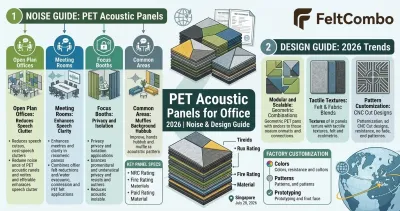
PET Acoustic Panels for Office 2026 | Noise & Design Guide
Fix open office noise in 2026 with PET acoustic panels. 100+ colors, ASTM E84 Class A, easy install. Feltcombo: factory-direct from China & Thailand. Free consultation.
-
![Eco-Friendly Acoustic Panels 2026 | GRS Recycled PET]()
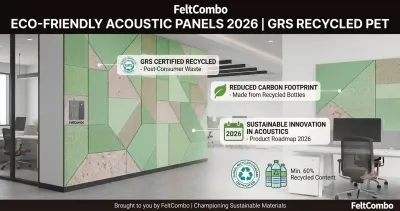
Eco-Friendly Acoustic Panels 2026 | GRS Recycled PET
Feltcombo's GRS-certified PET acoustic panels use ≥50% recycled content and are recyclable after use. Support LEED & BREEAM credits. Factory-direct, full sustainability documentation.
-
![Fire-Rated PET Acoustic Panels | ASTM E84 Class A Certified]()
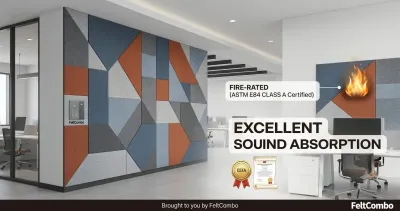
Fire-Rated PET Acoustic Panels | ASTM E84 Class A Certified
Feltcombo supplies ASTM E84 Class A, EN13501-B and BS476 Class 1 certified PET acoustic panels. Original test reports available. Factory-direct from China & Thailand.
-
![24mm PET Acoustic Panels | Studios, Cinemas & Bulk Projects]()
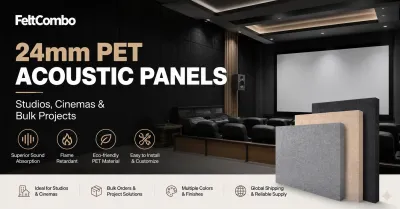
24mm PET Acoustic Panels | Studios, Cinemas & Bulk Projects
Source 24mm PET acoustic panels from Feltcombo's China & Thailand factories. Custom sizes, Class A fire rating, verified NRC data, and stable bulk supply for high-spec projects.
-
![12mm PET Acoustic Panels: NRC, Size & Fire Ratings Guide 2026]()
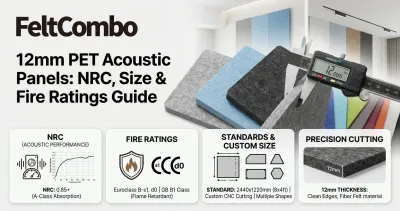
12mm PET Acoustic Panels: NRC, Size & Fire Ratings Guide 2026
Specify 12mm PET acoustic panels with confidence — NRC performance vs 9mm, 1225×2850mm format, BS476 Class 1 update, 59 stock colors, and China & Thailand factory supply explained for B2B buyers.
-
![9mm PET Acoustic Panels: Specs, Fire Ratings & Stock Guide 2026]()
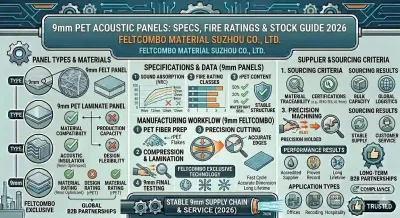
9mm PET Acoustic Panels: Specs, Fire Ratings & Stock Guide 2026
Everything B2B buyers need on 9mm PET acoustic panels — 1500 vs 1800gsm, ASTM E84 Class A & EN13501 Class B fire ratings, 39 stock colors, and China vs Thailand factory quality explained.
-
![PET Acoustic Panels: The Complete Guide to Materials & Sourcing 2026]()
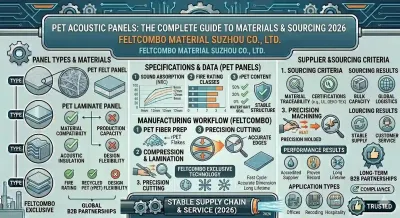
PET Acoustic Panels: The Complete Guide to Materials & Sourcing 2026
Everything B2B buyers need to know about PET acoustic panels in 2026 — NRC ratings, fire certifications (ASTM E84/EN13501), eco credentials, and how to source from a certified China & Thailand manufacturer.
-
![FeltCombo Presents High-Performance, Sustainable Acoustic Systems at CIFF Guangzhou 2026]()
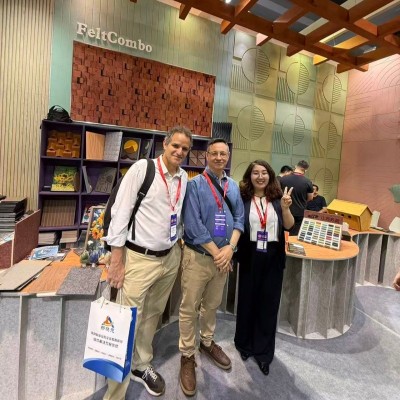
FeltCombo Presents High-Performance, Sustainable Acoustic Systems at CIFF Guangzhou 2026
FeltCombo Presents High-Performance, Sustainable Acoustic Systems at CIFF Guangzhou 2026