

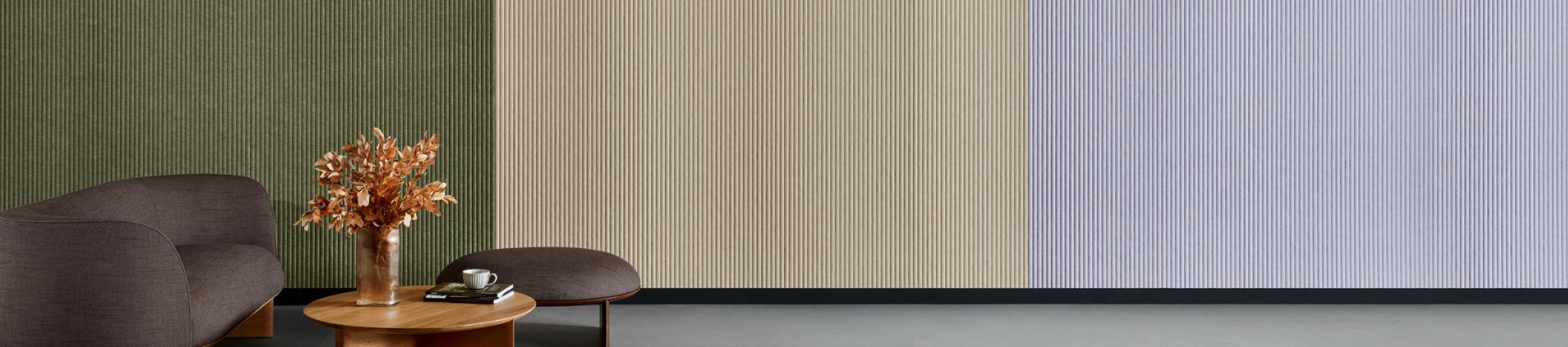
PET Acoustic Panels: The Complete Guide to Materials & Sourcing 2026
2026-05-01 00:08

by Mr. Xiao
Senior Product & Applications Specialist · Feltcombo Material Suzhou Co., Ltd.
10 Years in PET Acoustic Materials · 24+ Export Markets
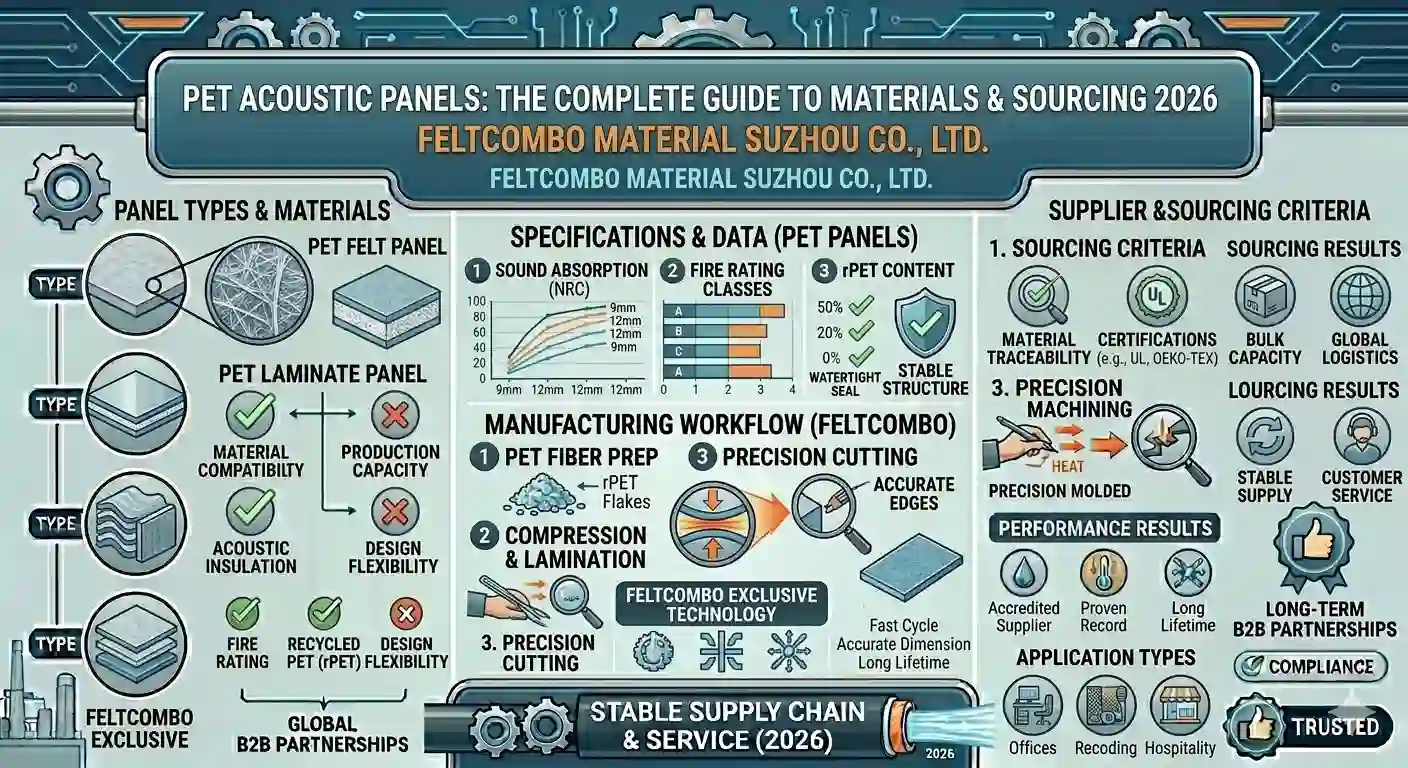
Let me be direct: most buyers who land on this page are already suspicious. They've heard "acoustic panels" pitched dozens of times — from trade show booths in Frankfurt to cold emails out of Guangdong — and they're still not entirely sure what separates a panel worth specifying from one that'll cause headaches six months into a project.
I've spent the better part of a decade inside PET acoustic panel manufacturing — watching batches go through production lines, reviewing fire test reports, shipping containers to distributors across 24 countries. What I want to do in this guide is give you the unfiltered picture: what these panels are made of, why the performance numbers actually matter, how the certifications work (and which ones you should refuse to accept on faith), and how to make a sourcing decision you won't regret.
This isn't a product catalogue. It's the guide I'd want to read if I were sitting on your side of the table.
📖 Table of Contents
What Are PET Acoustic Panels?
PET stands for polyethylene terephthalate — the same polymer that makes up plastic water bottles and food packaging. The acoustic panel industry figured out a long time ago that when you take post-consumer PET, melt it down, re-spin it into fine fibres, and then needle-punch or thermally bond those fibres into a dense mat, you get a material with genuinely impressive sound-absorbing properties.
The fibre structure is the key. Unlike a solid surface that reflects sound, a PET panel is essentially a three-dimensional maze of tiny air pockets. When sound waves enter the panel, they're forced to travel through that maze — and friction converts their kinetic energy into a negligible amount of heat. That's sound absorption in its simplest form.
Structurally, a standard PET acoustic panel looks like this:
Core layer: compressed PET fibres, typically at densities of 1,500 gsm (grams per square metre) or 1,800 gsm depending on the specification
Surface treatment: either left as a smooth pressed face, or processed through CNC cutting, embossing, thermoforming, or HD printing to create decorative finishes
Edge finish: precision-cut edges for tight installation tolerances (beveled, square, or custom profiles)
The resulting panel is rigid enough to handle and install without framing, yet light enough for a single person to mount on a wall or ceiling. Standard market sizes run 1,220 × 2,440 mm (the familiar 4' × 8' format) at 9 mm thickness, and 1,225 × 2,850 mm at 12 mm — though custom dimensions are entirely feasible with CNC processing.
What's worth underscoring from a procurement standpoint: not all PET panels are equal. The density, the fibre quality, the bonding process, and the fire-treatment chemistry all determine whether a panel performs as its supplier claims. A 9 mm panel at 1,500 gsm behaves very differently to one at 1,800 gsm, and neither will meet Class A fire standards without proper treatment. The spec sheet tells part of the story; the certification report tells the rest.
💡 Practical Take
When evaluating a PET panel supplier, ask for the GSM (density) of the product you're quoting — not just the thickness. Two panels of identical 9 mm thickness can have density specifications 20% apart, resulting in meaningfully different acoustic and structural performance.
PET vs. Traditional Acoustic Materials
Fiberglass, mineral wool, and melamine foam have been the backbone of the acoustic treatment industry for decades. They still have genuine applications. But in 2026, when a commercial client asks me why they should specify PET panels over those legacy materials, I don't have to work hard to make the case.
Here's an honest comparison across the dimensions that actually matter for commercial and hospitality projects:
| Criteria | PET Acoustic Panels | Fiberglass Panels | Mineral Wool Panels | Melamine Foam |
|---|---|---|---|---|
| NRC Range | 0.65 – 0.95 | 0.70 – 0.95 | 0.75 – 1.00 | 0.80 – 0.99 |
| Fire Rating Achievable | Class A (ASTM E84) Class B (EN13501) | Class A (inherently) | Class A (inherently) | Class B – C (varies) |
| Health & Safety (Install) | ✔ No irritant fibres | ⚠ Skin / respiratory irritant | ⚠ Respiratory irritant | ✔ Generally safe |
| VOC Emissions | None | Low (binder-dependent) | Low (binder-dependent) | Negligible |
| Recycled Content | ≥50% (GRS Certified) | Varies (often minimal) | Some recycled content | Virgin material |
| End-of-Life Recyclable | ✔ Fully recyclable | ✘ Landfill only | ✘ Difficult to recycle | ✘ Landfill only |
| Colour Options | 100+ standard + custom | Very limited | Very limited | Limited |
| Mould Resistance | Inherently mould-resistant | Can absorb moisture | Moderate resistance | Good |
| Installation | Direct mount, no framing | Usually requires framing | Often requires framing | Direct adhesive |
The story the table tells is fairly consistent: fiberglass and mineral wool win on raw NRC, especially at higher thicknesses, but they give up nearly everything else — safety during handling, colour flexibility, sustainability credentials, and end-of-life recyclability. In a 2026 procurement environment where green building certifications and occupant wellbeing are standard specifications rather than optional add-ons, those trade-offs matter enormously.
Melamine foam is worth a separate mention. It's genuinely effective at high frequencies, often specified in recording environments. But it has no structural integrity, no colour range, and no credible fire performance at Class A. It's not a substitute for a wall panel on a commercial project.
🎯 Pro Tip
If you're specifying for a LEED v4.1 or BREEAM project, the combination of GRS-certified recycled content (≥50% post-consumer PET) and zero VOC emissions means PET acoustic panels can simultaneously contribute to Materials & Resources credits and Indoor Environmental Quality credits. That's not something fiberglass or mineral wool can claim.
Key Performance Indicators: NRC, Density & Fire Class
Three numbers tell you most of what you need to know about a PET acoustic panel before you commit to a specification. I'll walk through each one without the marketing overlay.
Noise Reduction Coefficient (NRC)
NRC is a single-number rating that averages a material's sound absorption across four octave bands — 250 Hz, 500 Hz, 1,000 Hz, and 2,000 Hz — and rounds to the nearest 0.05. An NRC of 0.00 means the surface reflects all sound; 1.00 means it absorbs everything. Real-world materials sit between those extremes.
For PET panels, NRC is primarily a function of thickness and density. Here's what the data generally looks like:
| Thickness | Density | Typical NRC Range | Best-Fit Application |
|---|---|---|---|
| 9 mm | 1,500 gsm | 0.65 – 0.75 | General commercial, residential, retail |
| 9 mm | 1,800 gsm | 0.75 – 0.85 | Commercial offices, hospitality, education |
| 12 mm | 1,800 gsm | 0.80 – 0.90 | Higher-spec offices, conference rooms, hotels |
| 24 mm | 1,800 gsm | 0.90 – 0.95+ | Cinemas, recording studios, auditoriums |
One thing I want to be clear about: an NRC is only as reliable as the lab that produced it. Ask for the actual test report, not just the number on a data sheet. ISO 354 and ASTM C423 are the two methods most commonly referenced; both are valid, but they're conducted differently and results can vary slightly between them. If a supplier can't tell you which standard their NRC was measured to, treat that number with caution.
Density: 1,500 gsm vs. 1,800 gsm
Density affects NRC, but it also affects structural behaviour. Higher-density panels are stiffer, resist surface denting better, and tend to hold cut edges more cleanly — which matters when you're routing decorative patterns or applying CNC profiles. If you're specifying carved or embossed variants, I'd recommend a minimum of 1,800 gsm regardless of thickness.
Fire Classification
PET is inherently combustible. The fire performance of PET acoustic panels is entirely dependent on the fire-retardant chemistry applied during manufacture — either incorporated into the fibre during production (an additive approach) or applied as a treatment during pressing. Both methods can achieve Class A or Class B ratings when done properly, but the additive approach generally delivers more consistent results across the full production batch. Ask your supplier which method they use.
Fire Safety Certifications Explained
This is the section that most spec sheets gloss over, and it's the one that causes the most problems on commercial projects. Let me give you a clear, market-by-market breakdown of the standards that matter.
ASTM E84 — United States (Class A / Class B)
ASTM E84, known as the "Steiner Tunnel Test," measures two things: Flame Spread Index (FSI) and Smoke Developed Index (SDI). Class A requires FSI ≤ 25 and SDI ≤ 450. It's the gold-standard fire requirement for interior finish materials in US commercial construction and is referenced in the International Building Code (IBC). If you're supplying into the US market, Class A under ASTM E84 is essentially a non-negotiable for most commercial occupancy types.
One important note: ASTM E84 test reports have a physical test sample. If a supplier tells you their panel is "Class A certified" but can't produce the original test certificate with the accredited laboratory's name and report number, that claim should be verified independently before specification.
EN 13501-1 — European Union (Class A2 / Class B)
The European fire classification system uses Euroclass ratings: A1, A2, B, C, D, E, F — with A1 being non-combustible (think concrete) and F meaning no performance determined. For PET acoustic panels, Class B (EN13501-1) is the practical ceiling for organic fibre-based materials and is sufficient for the vast majority of European commercial applications including offices, retail, and hospitality. Class B requires reaction-to-fire testing under EN ISO 9239-1 or EN ISO 11925-2, plus smoke and droplet sub-classifications.
BS 476 Part 7 / Part 6 — United Kingdom (Class 1)
Post-Brexit, the UK maintains its own system alongside (and sometimes in addition to) the Euroclass framework. BS 476-7 Class 1 refers to surface spread of flame performance and remains a frequently specified standard for UK commercial projects, particularly in older project specs and local authority procurement. Class 1 under BS 476-7 is broadly equivalent to Euroclass B in terms of market acceptability for wall finishes.
AS ISO 9705 / AS NZS 1859 — Australia & New Zealand
The Australian market has its own testing hierarchy. AS ISO 9705 is the "room corner test" — a full-scale room fire test that is one of the most stringent fire evaluation methods globally. Group 1 classification under AS ISO 9705 is the highest-performance category and is a qualifying criterion under the National Construction Code (NCC) for materials in specified occupancy classes. This is not a test that can be bluffed — it requires a full-scale burn test in an accredited Australian laboratory.
| Certification | Standard / Method | Market | Feltcombo Status |
|---|---|---|---|
| ASTM E84 Class A | Steiner Tunnel Test | USA & Canada | ✔ Certified (9mm 1800gsm) |
| EN 13501-1 Class B | Euroclass System | EU & EU-aligned | ✔ Certified (9mm 1800gsm) |
| BS 476-1 Class 1 | Surface Spread of Flame | United Kingdom | ✔ Certified (12mm) |
| AS ISO 9705 Group 1 | Room Corner Test | Australia / NZ | ✔ Certified (9mm 1500gsm) |
| GRS (Global Recycled Standard) | Third-Party Chain of Custody | Global (LEED / BREEAM) | ✔ Certified (≥50% recycled PET) |
📎 Related reading: Fire-Rated PET Acoustic Panels: Understanding Class A Compliance for US & International Projects →
Top Application Scenarios in 2026
The market context heading into 2026 is worth articulating clearly. The global acoustic panel market — across all material types — was valued at approximately USD 14 billion and is growing steadily, driven by three structural forces: the open-plan office isn't going away (hybrid work has settled, not reversed), urban residential construction density continues to create noise problems, and green building codes are becoming more prescriptive about interior acoustic environments.
Within that broader market, PET acoustic panels are gaining share specifically because they solve the aesthetic problem that fiberglass and mineral wool cannot. Let me run through the major application categories as they stand in 2026.
Commercial Offices
This remains the dominant category by installation volume. The open-plan office was acoustically broken by design, and after years of trying to fix it with furniture and partitions, facilities teams are increasingly turning to wall and ceiling panels as the primary acoustic treatment strategy. The data is consistent: acoustic discomfort ranks as the top complaint in open office environments.
For offices, 9 mm panels at 1,800 gsm density typically deliver sufficient NRC for speech privacy and reverberation control. The real decision point in commercial office specification is usually colour and finish — because the panels are visible, and the interior designer has an opinion. Having 100+ standard colours in stock is not a cosmetic advantage; it's a practical one.
Hospitality: Hotels, Restaurants & Bars
Hospitality specifications are demanding. A hotel corridor wall panel needs to look premium, absorb sound, and pass a fire test that a building inspector won't challenge. The combination of Class A fire rating (for US and Australian markets), high NRC, and the full range of finish options — plain, carved, embossed, printed, or wood-veneer — makes PET panels the material of choice for a growing proportion of FF&E teams.
Restaurants present a particular acoustic challenge: hard surfaces everywhere (concrete, glass, tile), high occupancy, and clients who complain bitterly about noise but also want the space to feel lively and energetic. Ceiling and upper-wall PET panels are often the most effective and least intrusive acoustic treatment for dining environments.
Education: Schools, Universities, Libraries
Educational institutions were an early adopter of PET acoustic panels, partly because of the child-safety profile (no irritant fibres, no VOCs, mould-resistant) and partly because the colourful range aligns with the visual expectations of educational environments. Adoption rates for PET panels in educational acoustic installations have been rising consistently — from around 29% of installations in 2021 to approximately 44% by 2023, with further growth since.
Residential: Home Offices & Living Spaces
This is the segment that changed most dramatically post-2020. Home podcast studios, remote work setups, home cinemas, and even living rooms in dense urban apartments are now active markets for acoustic panels. PET panels work in residential contexts precisely because they don't look like acoustic treatment — with the right colour and finish selection, they look like a design feature.
Biophilic Design: 2026's Defining Aesthetic Trend
I'd be doing buyers a disservice if I didn't address the biophilic design trend directly, because it's reshaping specification patterns for acoustic materials in ways that weren't true five years ago. Biophilic design — the deliberate incorporation of natural materials, organic forms, and sensory variety into built environments — has moved from niche to mainstream in commercial and hospitality specifications.
Wood-veneer PET panels and acoustic wood slat panels sit at the intersection of acoustic performance and biophilic aesthetics. Natural and warm tones in PET panels (terracotta, sage, warm grey, sand) are among the fastest-moving SKUs in our current range — a shift that reflects broader colour forecasting trends rather than individual project preferences.
💡 Practical Take — 2026 Colour Trend
The fastest-growing colour requests we're seeing in early 2026: warm off-whites, dusty sage greens, terracotta tones, and deep charcoal greys. If you're specifying for a project that opens in the next 12–18 months, these are the palettes interior designers are currently working with. Custom colour development is available, but standard stock in these tones means much faster lead times.
How to Choose the Right PET Acoustic Panel
Choosing a PET acoustic panel comes down to answering four questions in order. Get these right, and the rest is details.
1. What thickness do you need?
9 mm is the standard for the vast majority of commercial and residential applications. It's light, relatively slim against the wall profile, and — at 1,800 gsm — delivers NRC performance that satisfies typical office, retail, and hospitality specifications. Standard stock sizes (1,220 × 2,440 mm) mean fast availability without custom lead times.
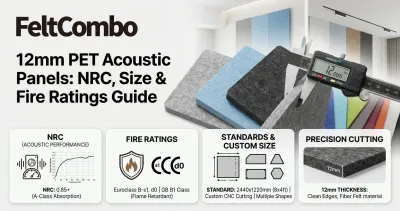
12 mm steps up the acoustic performance and is worth specifying when reverberation times are a primary concern — hotel conference rooms, university lecture halls, open-plan trading floors, airport lounges. The larger stock format (1,225 × 2,850 mm) is an underappreciated advantage: fewer joints means a cleaner visual finish and faster installation time.
24 mm is for situations where acoustic performance is the overriding criterion. Cinemas, recording studios, performing arts spaces, some healthcare applications. It's a higher-cost, longer-lead product, but for the right application it's the correct answer.
2. What fire certification does your project require?
Match the certification to the project's market and occupancy type. The table in Section 4 summarises this directly. Don't specify a panel without first confirming which standard applies to your jurisdiction and verifying that the supplier holds current test documentation for the specific product (not just the product family).
3. What finish type fits the design intent?
Plain / solid colour: Maximum versatility, fastest lead time (if in standard stock). Works in virtually any application.
Carved / routed patterns: CNC-cut decorative profiles — geometric, organic, custom. Adds visual interest without losing acoustic function.
Embossed: Surface texture created during the pressing process. More subtle than carved; works well in spaces that need texture without deep relief.
HD Printed: Full-surface photographic or graphic printing. For branded environments, feature walls, or hospitality spaces where visual impact is a primary design driver.
Wood Veneer PET: Real wood veneer laminated to a PET core. All the aesthetics of timber with the lighter weight and acoustic properties of PET.
4. What is your supply requirement?
If you need immediate delivery for an active project, work from stock. If you're planning 6–12 months ahead and need custom colour or finish, that lead time is your working window for development and production. For large-volume projects — multiple floors, multi-site rollouts — verify that your supplier can actually deliver at scale without batch inconsistency. "We can do it" and "we can do it consistently at your volume" are different answers.
📎 Related reading: 9mm vs 12mm vs 24mm PET Acoustic Panels: The Complete Specification Guide →
Why Source from a Certified Manufacturer?
I want to address something honestly: the PET acoustic panel market has a quality dispersion problem. The barrier to entry for making a basic PET felt panel is not high — the raw material (recycled PET fibre) is widely available, and the bonding process is relatively accessible. What that means in practice is that the market includes everything from manufacturers with Germany-designed production lines running 24/7 quality control protocols to small operations running uncertified products through discount channels.
The problem for buyers is that these products can look identical in photographs and similar on a data sheet. The differences show up in the test reports — and in the field, when a panel fails a building inspector's spot check, or when a batch delivered six months after the first order has visibly different density or colour consistency.
Here's what a credible manufacturer should be able to demonstrate:
Independently Verified Fire Certifications
Not a self-declared compliance statement — an actual test report from an accredited third-party laboratory, with a test date, a report number, and a product description that matches what you're buying. Fire certificates have validity periods and need to be renewed; a certificate from 2019 on a product that's been reformulated is not meaningful assurance.
GRS Certification for Recycled Content Claims
The Global Recycled Standard (GRS) is a full supply-chain traceability certification that verifies the recycled content percentage through independent audits at each production stage. If a manufacturer claims "50% recycled content" without GRS or an equivalent third-party certification, there's no independent verification of that claim. For buyers sourcing for LEED or BREEAM projects, GRS documentation is typically a prerequisite for material credit eligibility.
Production Scale and Process Control
The production process matters for quality consistency. At Feltcombo, we operate 12 PET acoustic panel production lines — four of which were designed in Germany — across our manufacturing bases in Jiangsu and Guangdong. Germany-designed lines matter not because of geography, but because the engineering specifications for line speed, pressing temperature, and density consistency are measurably tighter. When you're ordering 5,000 panels across three production runs, the consistency standards of the production equipment determine whether they all arrive looking and performing the same.
Dual-Country Production as a Supply Continuity Guarantee
Our Thailand factory, which has been operational since 2023, was not a marketing decision. It was a supply chain decision. The last five years have given the building materials industry a masterclass in what happens when production is concentrated in a single geography — port disruptions, force majeure events, tariff changes — and the buyers who were most insulated were those with suppliers holding inventory or production capacity in more than one country.
For North American buyers specifically, the Thailand origin certificate also provides options in navigating current import duty frameworks that a China-only supplier cannot offer.
💡 Supplier Verification Checklist
Request the original test certificate (not a data sheet summary) for each certification claimed
Verify the test date — certifications over 3–5 years old may not reflect current production
Ask for the GRS certificate number and verify it at textileexchange.org
Request a physical sample — colour and surface consistency should be assessed before committing to a large order
Ask how many production lines run your specific product — single-line operations have higher batch variation risk
Ask whether factory audits are available — a factory that welcomes audits is one that has nothing to hide
Feltcombo's PET Acoustic Panel Product Lines
Here's a straightforward overview of our current PET acoustic panel range. Each product family has a dedicated page with full specifications, certification documents, and sample request options.
| Product Line | Available Thicknesses | Stock Availability | Key Certifications |
|---|---|---|---|
| Plain PET Acoustic Panels | 9 / 12 / 24 mm | Yes (9mm: 39 colours; 12mm: 59 colours) | ASTM E84 A / EN13501 B / BS476-1 / GRS |
| Carved PET Acoustic Panels | 9 / 12 / 24 mm | Custom (sample available) | ASTM E84 A / EN13501 B / GRS |
| Embossed PET Acoustic Panels | 9 / 12 / 24 mm | Custom (standard patterns) | ASTM E84 A / EN13501 B / GRS |
| 3D PET Acoustic Panels | Custom profile | Custom only | ASTM E84 A / EN13501 B / GRS |
| Printed PET Acoustic Panels | 9 / 12 / 24 mm | Custom (HD print on any colour) | ASTM E84 A / EN13501 B / GRS |
| Wood Veneer PET Panels | Custom | Custom (sample service) | GRS (PET core) + certification on request |
| PET Acoustic Ceiling Panels | Custom | Custom (baffles + ceiling clouds) | ASTM E84 A / EN13501 B / GRS |
Our standard stock programme covers 9 mm (39 colours, 1,220 × 2,440 mm) and 12 mm (59 colours, 1,225 × 2,850 mm), both flame-retardant as standard. For project quantities that require consistent colour across large volumes, stock availability is the single biggest variable in lead time — and it's one we've invested deliberately in building.
New colour development is available. Our supply chain partnerships support custom colour matching against Pantone, NCS, or RAL references, with development cycles that are competitive for the category. If you're working on a project with a defined colour palette, get in touch early — colour development lead time is the variable most likely to constrain your project schedule.
FAQ: MOQ, Lead Time, Custom Colour & Certifications
Q: What is the minimum order quantity (MOQ) for PET acoustic panels?
For stock products (9 mm and 12 mm plain panels), our MOQ is designed to accommodate both project-scale procurement and trial orders. The specific MOQ varies by product line and destination — please contact us directly for a current quote. For custom products (carved, embossed, printed, or custom colour), minimum quantities are higher due to set-up and tooling requirements; we'll provide full details at the inquiry stage.
Q: What are typical lead times for stock and custom orders?
Stock products (9 mm in 39 colours, 12 mm in 59 colours) are held in regular inventory in our Jiangsu facility and can typically be dispatched within 5–10 business days of order confirmation. Custom orders — including non-standard colours, carved or embossed patterns, and HD printed panels — require production scheduling; lead times range from 3–6 weeks depending on complexity and current production load. Thailand factory orders have comparable lead times but ship from a different port, which affects ocean freight scheduling. We recommend getting in touch 8–12 weeks before your required-on-site date for any custom project.
Q: Can you develop a custom colour that matches our brand standards?
Yes. We actively follow colour trend forecasting and have an established supply chain for custom colour development. Colour matching can be done against Pantone, NCS, RAL, or a physical sample you provide. Development time is typically 3–6 weeks for colour confirmation, followed by production lead time. There is usually a minimum batch requirement for new colour development — contact us with your project specifics and we'll advise on feasibility and timeline.
Q: Can you provide original certification documents for fire tests and GRS?
Yes, always. We hold original test certificates from accredited third-party laboratories for all certified products. These are not data sheet summaries — they are the full test reports, including the laboratory accreditation details, test method references, test dates, and product descriptions. GRS certification documents include our certification number and are verifiable through the Textile Exchange database. We provide full documentation packages as part of any B2B inquiry process.
Q: Is factory audit or site visit possible?
Absolutely. We actively welcome customer visits to our manufacturing bases and showrooms in Jiangsu and Guangdong. If you're in a position to visit, we'll arrange a full factory tour covering the production lines, QC processes, and sample room. For customers who cannot travel, we can arrange a live video walkthrough. The invitation is genuine — a factory that's serious about its quality standards has no reason to keep customers at arm's length.
Q: What countries do you currently supply to, and do you have experience with import documentation?
We've shipped to 24+ countries, including major markets across North America, Europe, the UK, Australia, and the Middle East. Our export operations team handles commercial invoices, packing lists, certificates of origin (including Thailand COO for applicable trade routes), test report packages, and any additional documentation your customs broker requires. If you have specific documentation requirements for your market, let us know at the inquiry stage and we'll confirm what we can provide.
Ready to Specify or Source PET Acoustic Panels?
Feltcombo supplies PET acoustic panels to 24+ countries from certified China & Thailand factories.
Request samples, get certification documents, or discuss a custom project — we respond within 24 hours.
Mr. Xiao
Senior Product & Applications Specialist · Feltcombo Material Suzhou Co., Ltd.
Mr. Xiao has been working in PET acoustic material manufacturing for over 10 years, with direct experience in raw material sourcing, production quality control, product development, and export to 24+ countries. He oversees technical content and application guidance at Feltcombo, and is available to answer sourcing and specification questions through the company's contact channels.
References
Verified Market Reports. PET Acoustic Panels Market Size, SWOT, Competitive Analysis & Forecast. 2025. — Market valued at USD 1.25 billion in 2024; projected CAGR 8.5% through 2033.
360iResearch. PET Felt Acoustic Panels Market Size & Share 2026–2032. 2026. — PET Felt Acoustic Panels market estimated at USD 431.19 million in 2026; CAGR 4.74% to 2032.
Global Market Insights. Acoustic Panel Market Size & Share, Statistics Report 2026–2035. January 2026. — Global acoustic panel market valued at USD 8.6 billion in 2025; CAGR 6.7% through 2035.
MarketGrowthReports. PET Acoustic Panels Market Size & Forecast [2033]. 2024. — In 2024, over 67% of office refurbishments included acoustic installations; PET panels comprised 39% of those upgrades.
DataHorizzon Research via OpenPR. Global PET Felt Acoustic Panels Market to Hit USD 1200 Million by 2033. March 2026. — Acoustic discomfort ranked #1 complaint in office environments; 31% surge in retrofitting projects in 2025.
ASTM International. ASTM E84 Standard Test Method for Surface Burning Characteristics of Building Materials. Current edition.
European Committee for Standardisation (CEN). EN 13501-1: Fire Classification of Construction Products and Building Elements. Current edition.
British Standards Institution. BS 476-7: Fire Tests on Building Materials and Structures — Surface Spread of Flame. Current edition.
Standards Australia. AS ISO 9705: Fire Tests — Full-Scale Room Test for Surface Products. Current edition.
Textile Exchange. Global Recycled Standard (GRS) Version 4.0. textileexchange.org.
Related News
Read More >-
![PET Acoustic Panels for Office 2026 | Noise & Design Guide]()
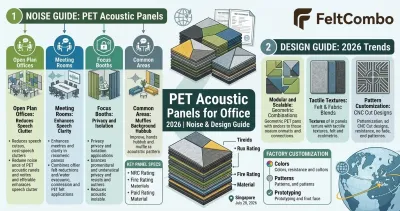
PET Acoustic Panels for Office 2026 | Noise & Design Guide
Fix open office noise in 2026 with PET acoustic panels. 100+ colors, ASTM E84 Class A, easy install. Feltcombo: factory-direct from China & Thailand. Free consultation.
-
![PET Acoustic Panels Manufacturer China | 2026 Sourcing Guide]()
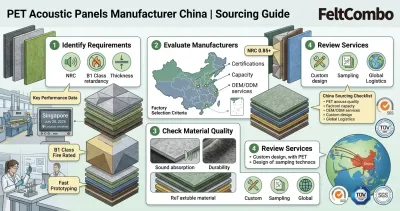
PET Acoustic Panels Manufacturer China | 2026 Sourcing Guide
How to choose a reliable PET acoustic panel factory in China. ASTM E84, EN13501 & GRS certified. Feltcombo: 3 China bases + Thailand, 10 years experience, 24+ countries.
-
![Eco-Friendly Acoustic Panels 2026 | GRS Recycled PET]()
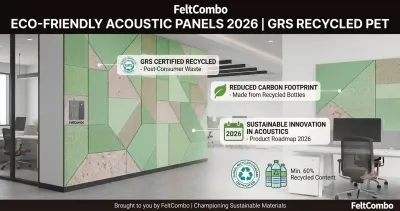
Eco-Friendly Acoustic Panels 2026 | GRS Recycled PET
Feltcombo's GRS-certified PET acoustic panels use ≥50% recycled content and are recyclable after use. Support LEED & BREEAM credits. Factory-direct, full sustainability documentation.
-
![Fire-Rated PET Acoustic Panels | ASTM E84 Class A Certified]()
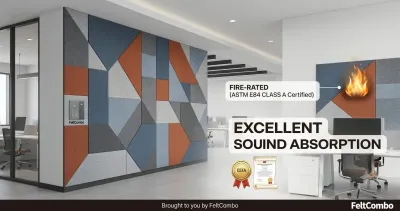
Fire-Rated PET Acoustic Panels | ASTM E84 Class A Certified
Feltcombo supplies ASTM E84 Class A, EN13501-B and BS476 Class 1 certified PET acoustic panels. Original test reports available. Factory-direct from China & Thailand.
-
![24mm PET Acoustic Panels | Studios, Cinemas & Bulk Projects]()
24mm PET Acoustic Panels | Studios, Cinemas & Bulk Projects
Source 24mm PET acoustic panels from Feltcombo's China & Thailand factories. Custom sizes, Class A fire rating, verified NRC data, and stable bulk supply for high-spec projects.
-
![12mm PET Acoustic Panels: NRC, Size & Fire Ratings Guide 2026]()
12mm PET Acoustic Panels: NRC, Size & Fire Ratings Guide 2026
Specify 12mm PET acoustic panels with confidence — NRC performance vs 9mm, 1225×2850mm format, BS476 Class 1 update, 59 stock colors, and China & Thailand factory supply explained for B2B buyers.
-
![9mm PET Acoustic Panels: Specs, Fire Ratings & Stock Guide 2026]()
9mm PET Acoustic Panels: Specs, Fire Ratings & Stock Guide 2026
Everything B2B buyers need on 9mm PET acoustic panels — 1500 vs 1800gsm, ASTM E84 Class A & EN13501 Class B fire ratings, 39 stock colors, and China vs Thailand factory quality explained.
-
![FeltCombo Presents High-Performance, Sustainable Acoustic Systems at CIFF Guangzhou 2026]()
FeltCombo Presents High-Performance, Sustainable Acoustic Systems at CIFF Guangzhou 2026
FeltCombo Presents High-Performance, Sustainable Acoustic Systems at CIFF Guangzhou 2026