

12mm PET Acoustic Panels: NRC, Size & Fire Ratings Guide 2026
2026-05-31 21:00

Written by Mr. Xiao
Senior Product & Applications Specialist · Feltcombo Material Suzhou Co., Ltd.
10 Years in PET Acoustic Materials · 24+ Export Markets · China & Thailand Dual-Factory
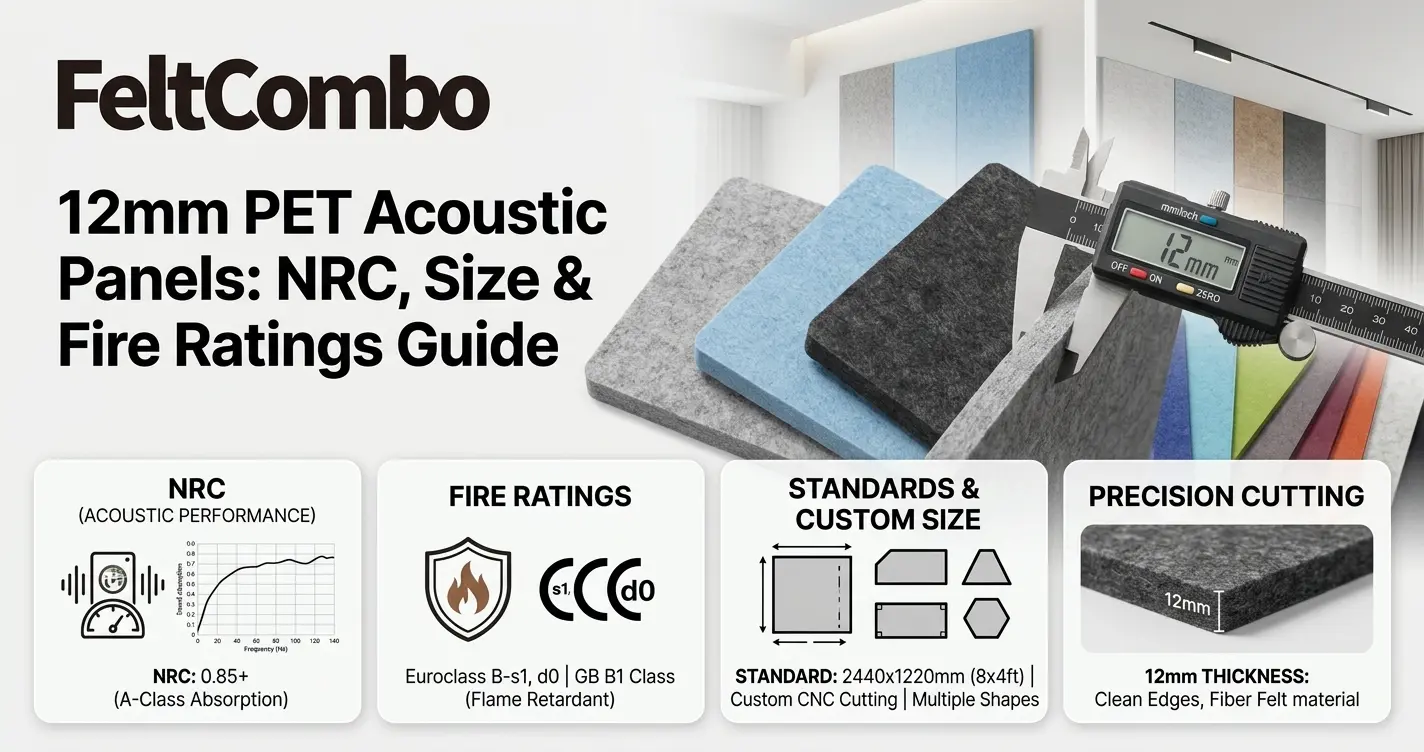
Most conversations about PET acoustic panels start and end at 9 mm. It's the industry standard, it's what distributors stock, and it's what gets specified by default on the majority of commercial projects. I've written about 9 mm extensively, and it genuinely deserves its dominant position in the market.
But 12 mm is where the conversation gets interesting for buyers who are working on demanding projects — and by demanding, I mean projects where someone in the specification chain is actually running reverberation time calculations, or where the architect has specified panel sizes that eliminate visible joints, or where the fire inspector is from the UK and has very specific documentation expectations.
In this guide, I want to cover what 12 mm actually delivers over 9 mm — not with vague claims about "better performance," but with the specific numbers and the specific scenarios where those numbers matter. I also want to address the UK fire certification situation directly, because the regulatory landscape changed significantly in March 2025 and there's still considerable confusion in the market about what's now required and what documentation remains valid.
If you're a project procurement manager, acoustic engineer, or hotel design specifier who's arrived here wondering whether 12 mm is the right call for your next project, this should answer that question.
📖 Table of Contents
9mm vs. 12mm: When Does Thickness Actually Matter?
The honest answer is: thickness matters when it changes the outcome of an acoustic calculation, when it changes the certification tier you can access, or when it changes the installation logistics in a way that affects project cost. Those three conditions are more specific than they sound, so let me unpack them.
When Thickness Changes Acoustic Outcomes
Moving from 9 mm to 12 mm at the same density (1,800 gsm) delivers a meaningful NRC improvement — roughly 0.05 to 0.10 in the mid-frequency bands that govern speech intelligibility. That delta matters on projects with tighter reverberation time targets. A conference room specified to achieve RT60 ≤ 0.4 seconds, a hotel conference suite with a specified IACC (Interaural Cross-correlation Coefficient), or an open trading floor with a speech transmission index (STI) target — these are the contexts where the difference between NRC 0.80 and NRC 0.90 changes whether a specification passes or requires additional treatment.
For simpler spaces — a retail store, a residential corridor, a straightforward open-plan office — 9 mm at 1,800 gsm typically delivers sufficient absorption and the additional NRC from 12 mm doesn't change the acoustic outcome meaningfully. The cost per square metre is higher at 12 mm, and that premium needs to be justified by a specific performance requirement, not just a vague sense that "thicker must be better."
When Thickness Changes the Certification Tier
This is less intuitive but important. Our 12 mm product carries BS 476-1 Class 1 certification — a rating that was historically the primary fire compliance reference in UK specifications. It's a separate test from ASTM E84 and EN 13501-1, using a different methodology, and the 12 mm panel's construction achieves this classification at the 12 mm profile in a way that the 9 mm product doesn't hold as a certified document.
I'll address the current UK regulatory status of BS 476-1 in detail in Section 4 — the situation changed in March 2025 and there's important context any UK-focused buyer needs to understand before writing a specification around it.
When Thickness Changes Installation Logistics
The 12 mm product ships in a larger standard size — 1,225 × 2,850 mm versus 1,220 × 2,440 mm for 9 mm. That larger format directly affects installation speed, joint count, and visual finish. I'll cover this in detail in Section 3. For large-area projects, the installation economics can shift enough to offset the higher per-unit cost of 12 mm panels.
| Decision Factor | 9mm / 1800gsm | 12mm / 1800gsm | Verdict |
|---|---|---|---|
| NRC (mid-frequency, wall-mounted) | 0.80 – 0.90 | 0.90 – 1.00 | 12mm for critical acoustic specs |
| Standard Panel Size | 1220 × 2440mm | 1225 × 2850mm | 12mm for fewer joints & faster install |
| Stock Colour Range | 39 colours | 59 colours | 12mm wins on colour variety |
| Fire Certifications (current) | ASTM E84 Class A EN13501 Class B AS ISO 9705 Group 1 | BS 476-1 Class 1 EN13501 Class B (see Section 4) | Depends on project market |
| Panel Weight (per panel) | ~5.4 kg | ~7.8 kg | 9mm for single-person ceiling install |
| Surface Rigidity | Higher | Highest | 12mm for carved / deep-routed profiles |
| Best-Fit Application | General commercial, retail, education | Hotels, conference suites, auditoriums, trading floors | Specify 12mm when NRC or size matters |
💡 Practical Take — The Thickness Decision in One Sentence
If your project has a specific acoustic performance target (RT60, STI, or NRC ≥ 0.90), a ceiling height above 2,700 mm that benefits from a larger panel format, or a UK fire specification requirement, those are the three triggers for moving from 9 mm to 12 mm. Absent those conditions, 9 mm at 1,800 gsm does the job at lower cost.
NRC Performance Deep Dive: What 12mm Delivers
The Noise Reduction Coefficient (NRC) is a single-number average of a material's sound absorption across the 250 Hz, 500 Hz, 1,000 Hz, and 2,000 Hz octave bands. It runs from 0.00 (total reflection) to 1.00 (total absorption), rounded to the nearest 0.05. The industry uses it as the primary acoustic comparison metric because it's standardised, third-party tested, and directly applicable to room acoustic calculations.
For 12 mm PET panels at 1,800 gsm, the NRC typically falls in the 0.90–1.00 range for wall-mounted installation without an air gap. That's a meaningful step up from the 0.80–0.90 range typical for 9 mm at the same density. But the raw number only tells part of the story — the frequency distribution of that absorption is what determines whether 12 mm is actually the right call for a specific project.
Octave-Band Absorption: Where 12mm Gains
The performance improvement from 12 mm over 9 mm is not uniform across the frequency spectrum. The gains are most pronounced at lower frequencies — particularly the 250 Hz and 500 Hz bands — where porous absorbers of all types benefit from increased material thickness. At 1,000 Hz and 2,000 Hz (the core speech frequency range), both 9 mm and 12 mm at 1,800 gsm perform well, with 12 mm showing modest but measurable improvement.
The practical implication: if your project is primarily concerned with speech intelligibility in a standard office or retail context, the incremental gain from 12 mm in the critical speech bands may not justify the cost premium. But if the project involves a space with significant lower-frequency noise sources — mechanical systems, traffic ingress, music from adjacent spaces — the 12 mm product's improved low-frequency performance is a meaningful design tool.
| Frequency Band | 9mm / 1800gsm (α) | 12mm / 1800gsm (α) | Acoustic Relevance |
|---|---|---|---|
| 125 Hz | 0.10 – 0.20 | 0.15 – 0.25 | Low-frequency HVAC rumble |
| 250 Hz | 0.45 – 0.60 | 0.60 – 0.75 | Low male voice; room warmth control |
| 500 Hz | 0.75 – 0.85 | 0.88 – 0.95 | Core speech; fundamental frequencies |
| 1,000 Hz | 0.88 – 0.95 | 0.95 – 1.00 | Primary speech intelligibility band |
| 2,000 Hz | 0.90 – 0.98 | 0.95 – 1.00 | Consonant clarity; voice articulation |
| NRC (single number) | 0.80 – 0.90 | 0.90 – 1.00 | Average of 250 / 500 / 1000 / 2000 Hz bands |
One point that acoustic engineers will recognise but that often gets lost in procurement conversations: NRC is tested in a reverberation room under controlled laboratory conditions, not in a real project space. To determine NRC, materials are tested in a reverberation chamber where sound absorption is measured at multiple frequencies and then averaged. The actual acoustic outcome in any given room depends on room volume, geometry, surface area treated, and installation method — all variables that interact with the panel's NRC but aren't captured by the number alone.
The implication for specifiers: for critical listening environments like auditoriums or recording facilities, always request the full octave-band absorption coefficients rather than relying on the single-number NRC. For a hotel ballroom or university lecture theatre — the kinds of spaces where 12 mm is commonly specified — the full octave-band data is what your acoustic consultant needs, not just the headline NRC figure. We can provide this data for our 12 mm product as part of the documentation package.
🎯 Pro Tip — Air Gap Effect
Mounting a 12 mm PET panel with a 25–50 mm air cavity between the panel and the wall substrate significantly improves low-frequency absorption — often pushing the effective NRC above 1.00 at 500 Hz and extending meaningful absorption down to 125 Hz. If your project space has a low-frequency problem and you're already specifying 12 mm panels, it's worth discussing a standoff mounting system with your installer. The air gap costs almost nothing in labour and can materially change the acoustic outcome in problem spaces.
Size Advantage: 1225×2850mm vs. Standard 1220×2440mm (Fewer Joints, Cleaner Finish)
The 1,225 × 2,850 mm format of the 12 mm product is not just a different number on a data sheet. It changes the installation mathematics in ways that compound across a large project — and in high-end commercial and hospitality contexts, those changes translate directly into cost and visual quality differences that are worth articulating clearly.
Joint Count Reduction
The area of a 1,225 × 2,850 mm panel is 3.49 m². Compare that to the 2.97 m² of a 1,220 × 2,440 mm panel. The larger panel covers approximately 17.5% more area per unit. For a 500 m² wall treatment project, that's the difference between roughly 143 large panels and 169 standard panels — 26 fewer panels to handle, install, and align. In a hotel corridor project running 1,000 m² of wall treatment across multiple floors, the difference in panel count and the associated reduction in horizontal joints can be a deciding procurement factor.
The visual argument for fewer joints is straightforward: every visible joint is a potential alignment issue, a potential colour-matching inconsistency between batches, and an aesthetic interruption in what should be a continuous surface. In hospitality interiors where visual refinement is a specification priority, specifying the larger format where the ceiling height allows is a simple way to improve the final finish quality.
Ceiling Height Compatibility
The 2,850 mm length of the 12 mm panel is particularly relevant in commercial buildings where floor-to-ceiling heights run 2,700–3,200 mm — a range increasingly common in contemporary office and hotel construction as clients demand higher-ceiling environments. At 2,700 mm ceiling height, a 2,850 mm panel can be cut to fit with minimal waste. At 2,400 mm ceiling height — the standard in older commercial stock — both panel lengths require cutting, but the larger panel's proportions may produce better cutting yield depending on layout.
Width Consideration
The 1,225 mm width of the 12 mm product versus 1,220 mm for the 9 mm format is a 5 mm difference that is practically irrelevant from an installation standpoint. Both widths sit outside the standard 600 mm stud module, so neither product aligns to framing without intermediate cutting anyway. The width difference does not change the procurement or installation calculation meaningfully.
💡 Practical Take — Specifying Panel Size for Your Ceiling Height
Before committing to a panel format, calculate the cutting yield for your specific ceiling height. At 2,700 mm, a single 2,850 mm panel gives you approximately 150 mm of cutting allowance — enough for a clean cut with edge relief. At 3,000 mm, you'll need to run panels in two courses with a horizontal joint, regardless of which product you specify. If you're uncertain about yield calculation for a specific space, send us the floor plan dimensions and we'll work through the panel layout and quantity calculation for you.
📎 Related reading: 9mm PET Acoustic Panels: Specs, Fire Ratings & Why They're the #1 Stock Choice in 2026 →
BS476-1 Class 1 Certification — Critical Context for UK Projects in 2026
I need to address this section with more precision than the topic typically receives in supplier literature, because the UK fire certification landscape changed substantially in March 2025 and the implications for buyers haven't fully filtered through into procurement practice yet.
What Changed: March 2025
On 2 March 2025, the UK government withdrew BS 476 Part 7 from Approved Document B of the Building Regulations in England and Wales. In its place, EN 13501-1 is now the mandatory standard for reaction-to-fire classification of all construction products in England and Wales. This was a direct recommendation from the Grenfell Tower Inquiry, and it is now in full effect.
The practical consequence: any construction product specified for a UK project that relies solely on a BS 476-7 classification is referencing a withdrawn standard. This does not automatically make the product non-compliant, but it means the fire classification data is no longer recognised under current Building Regulations. New projects require EN 13501-1 classification.
This is not a theoretical concern. It means that if you're a UK-based project procurement manager writing a specification in 2026 and you reference "BS 476-7 Class 1" as your fire compliance requirement, you're citing a standard that building control bodies in England and Wales are now expected to treat as insufficient for new construction. Scotland and Northern Ireland have their own regulatory frameworks and should be confirmed separately.
What This Means for Feltcombo's 12mm Product
Our 12 mm product holds BS 476-1 Class 1 certification — a document that reflects test results conducted under the historical BS 476 methodology. While many projects also reference European classifications, BS 476 remains familiar language in specifications, contractor submittals, and legacy building documentation.
For UK projects on existing buildings, renovation projects referencing legacy specifications, or projects in Scotland and Northern Ireland where the regulatory update timeline differs, the BS 476-1 Class 1 certificate remains a meaningful and requested document. We provide it and stand behind it.
For new construction projects in England and Wales, the relevant certification is now EN 13501-1. Our 12 mm product's fire performance is consistent with EN 13501-1 Class B — and we are in the process of completing formal EN 13501-1 testing on the 12 mm specification. If you're working on an England/Wales new-build project with a 2026 or later completion date, contact us to confirm the current certification status for your specific product and we will give you an accurate, current answer rather than directing you to a certificate that may not satisfy your building control officer.
The Bigger Picture for Procurement Teams
The withdrawal of BS 476-7 is part of a broader alignment of UK fire testing with European methodology post-Grenfell. EN 13501-1 is a fundamentally more comprehensive, more rigorous, and more revealing standard than BS 476-7 ever was. The transition creates a documentation gap for some suppliers who hold only BS 476-7 certifications and haven't yet completed EN 13501-1 testing. As a buyer, it's worth asking any UK-supply acoustic panel manufacturer whether their fire certification is current under the March 2025 regulatory change — not as a gotcha question, but because a supplier who isn't aware of or has not responded to this change is a supplier with a compliance risk in their product documentation.
| Standard | Status in UK (2026) | Applicable Scenario | Feltcombo 12mm |
|---|---|---|---|
| BS 476-7 Class 1 | ⚠ Withdrawn from Approved Doc B (Mar 2025) — England & Wales | Legacy specs, existing buildings, Scotland / NI | ✔ Certified |
| EN 13501-1 Class B | ✔ Now mandatory — England & Wales new construction | All UK new-build projects 2025 onwards | ⏳ In Progress — Contact Us |
| ASTM E84 Class A | N/A for UK Building Regs | US / Canada projects; international hotel brands with US-aligned specs | See 9mm product |
🎯 Pro Tip — For UK Specifiers & Procurement Managers in 2026
Before writing a fire compliance clause into a UK project specification, confirm with your building control officer whether they will accept BS 476-7 documentation for the specific occupancy type and construction classification. For new construction in England and Wales, the answer is likely no — and you should specify EN 13501-1 Class B as your compliance requirement. Contact us with your project details and we'll confirm current certification availability and expected timeline for EN 13501-1 on our 12mm product.
59 Stock Colors: Fast Procurement Without Custom Lead Times
The 59 stock colours in the 12 mm range is, genuinely, one of the most commercially significant features of this product — and it's underappreciated by buyers who haven't tried to source 12 mm acoustic panels in a wide colour range from other manufacturers.
Most manufacturers who carry 12 mm PET acoustic panels at all treat it as a semi-custom product. The standard offering might be 8–15 colours, with anything outside that range carrying a custom lead time of 6–12 weeks and a minimum batch requirement that doesn't work for single-project procurement. The implication: a designer who wants a specific sage green or terracotta at 12 mm thickness from most sources either compromises on colour or accepts a lead time that blows the project programme.
Our 59-colour stock programme at 12 mm was built specifically to close that gap. It means a project procurement team can specify a 12 mm panel in a colour that matches their interior palette without triggering custom development, and receive it within normal stock lead times.
What 59 Colours Covers in Practice
The 59-colour range at 12 mm is broader than the 39-colour range at 9 mm — which is itself already a comprehensive range. The expanded palette at 12 mm adds:
Extended neutral spectrum: Additional warm whites, cool whites, greige tones, and mid-grey variants that provide more precision in matching architectural finishes
Expanded earth and nature palette: More specific terracotta, clay, sage, moss, and stone tones reflecting the current biophilic design movement in hospitality and commercial specifications
Additional deep and accent colours: More specific navy, burgundy, forest, and slate variants for feature wall applications
Hospitality-oriented colourways: Several tones that were added specifically in response to hotel and restaurant design briefs — a dusty rose, a muted gold, a warm taupe — that are in active use in hospitality fit-outs across Europe and the Middle East
| Colour Group | Available in 9mm (39 colours) | Available in 12mm (59 colours) | Primary Application |
|---|---|---|---|
| Whites & Off-whites | ✔ In stock | ✔ Extended range | Offices, healthcare, education |
| Greys & Charcoals | ✔ In stock | ✔ Extended range | Corporate offices, tech campuses |
| Earth & Terracotta Tones | ✔ In stock | ✔ Broader range | Hospitality, wellness centres |
| Greens (sage, moss, forest) | ✔ Limited stock | ✔ Full biophilic palette | Biophilic design, hotels, F&B |
| Hospitality Signature Tones | Not in 9mm stock | ✔ 12mm exclusive | Hotel lobbies, restaurants, spas |
| Deep Accents (navy, burgundy) | ✔ In stock | ✔ Extended variants | Feature walls, branded environments |
One operational note that matters for project procurement: all 59 colours are held as regular inventory, not as safety stock that might be unavailable on short notice. This means colour availability can be confirmed at inquiry stage, not as an approximation. If you're building a project programme that depends on a specific colour being available in six months, we can discuss forward reservation arrangements that protect your supply position.
📎 Related reading: The Complete Guide to PET Acoustic Panels: Materials, Performance & Sourcing in 2026 →
Hotel, Auditorium & Open Office: Real Project Use Cases
Theory and data are useful, but the application scenarios where 12 mm panels are actually specified are where the product decision crystallises. Let me walk through three of the most common project types and what specifying 12 mm actually means in practice for each.
Hotels: Ballrooms, Conference Suites & Guest Corridors
Hotel acoustic specifications have become more rigorous over the past decade. The modern hotel specification process for a 4- or 5-star property typically involves an acoustic consultant's report, and that report will usually set a specific RT60 target for each room type: 0.3–0.5 seconds for conference rooms, 0.5–0.8 seconds for ballrooms and event spaces, and 0.4–0.6 seconds for restaurant dining areas.
In a hotel ballroom or large conference suite with 4–6 metre ceiling heights, hard floor finishes, and minimal soft furnishings, achieving those targets requires serious surface absorption — and 12 mm panels are frequently part of the specification alongside ceiling treatments. The amount of surface area you treat directly affects acoustic performance: 40–50% coverage is appropriate for most meeting rooms, while 60–80% coverage delivers excellent control for speech-critical spaces. At those coverage percentages, the panel count for a large hotel room is significant — and the reduced joint count from the larger 12 mm panel format becomes a visible quality advantage in a space where visual finish is part of the brand.
Hotel corridors are a different application. Here, the acoustic goal is noise attenuation from adjacent rooms and lift lobbies, combined with reverberation reduction in what is typically a hard-surfaced tunnel of a space. 12 mm panels in the corridor application deliver noticeably better low-frequency absorption than 9 mm — which matters because the impact sounds and low-frequency ingress from guest rooms that disturb other guests are predominantly in the 125–500 Hz range where 12 mm has its performance advantage.
Auditoriums: University Lecture Theatres & Performance Spaces
Auditoriums require acoustic analysis beyond panel specification. The room's geometry, volume, reflective surfaces, and HVAC noise all interact with the panel treatment. For these projects, acoustic panel specification should follow a room acoustic model prepared by an acoustic consultant, rather than being determined from general guidelines.
Within that acoustic model, 12 mm PET panels are typically specified on rear walls and side walls to manage late reflections that cause echo and speech smear. Rear wall reflections from walls behind listeners arrive later and can cause echo and speech smear — treating rear walls is essential in conference rooms, classrooms, and auditoriums. The 12 mm product's improved low-frequency absorption is particularly valuable in lecture theatres where the HVAC system is a background noise source and where speech at the lectern needs to project clearly without excessive reverberation building up.
For performing arts spaces where music is a primary use — recital halls, choral rehearsal rooms, drama studios — the specification becomes more complex because too much absorption damages the acoustic for music even as it improves speech clarity. These are the projects where an acoustic consultant's frequency-specific recommendations should drive the specification, and where we'd recommend requesting full octave-band data from any panel supplier rather than working from headline NRC alone.
High-Specification Open Offices: Trading Floors & Executive Suites
The conventional open-plan office can usually be adequately treated with 9 mm panels. But there's a tier of commercial office specification — financial trading floors, executive leadership suites, board and strategy rooms — where "adequately treated" isn't the standard. These spaces have specific speech privacy requirements (confidentiality of financial discussions or strategic conversations), higher noise generation from technology infrastructure, and a visual specification that demands a premium finish quality.
For trading floors and executive environments, 12 mm panels are often specified for three concurrent reasons: the higher NRC for tighter RT60 control, the larger panel format for a seamless visual finish that matches the premium interior quality, and the available colour range for precise palette matching with the interior designer's specification. The 59-colour stock range is particularly relevant here — executive interior designers don't compromise on colourways, and having 59 options in stock versus 39 means the 12 mm product can meet that specification without custom development.
💡 Practical Take — When to Call an Acoustic Consultant First
If your project is a hotel ballroom above 500 m², a university auditorium, a performing arts space, or a trading floor with strict speech privacy requirements, the acoustic specification should start with a room acoustic model — not with a panel selection. The panel spec follows the model, not the other way around. We can provide full technical data (octave-band absorption coefficients, mounting condition variants) to any acoustic consultant working on your project. Contact us and we'll put together the technical documentation package they need.
Feltcombo Factory Capability: 12-Line Production + Thailand Backup Capacity
Production capability is the part of a supplier pitch that most buyers hear as background noise — everyone claims to have capacity, everyone claims to maintain quality. I'll try to give you the specific information that actually differentiates our manufacturing position from a generic claim.
12 Production Lines Including 4 Germany-Designed Units
We operate 12 PET acoustic panel production lines across our three Chinese manufacturing bases in Jiangsu and Guangdong. Four of those lines were specifically designed in Germany — which matters not as a branding claim but as a production engineering fact. German-designed lines run to tighter engineering tolerances in three critical parameters: pressing temperature profile (which governs fibre bonding uniformity and therefore density consistency), line speed calibration (which determines panel flatness and dimensional consistency), and surface finishing specification (which affects the precision of the pressed face and therefore the quality of any subsequent CNC, embossing, or printing process).
For a buyer ordering 12 mm panels across multiple container shipments, the production line specification is what determines whether panels from container three look and perform identically to panels from container one. Density variation between production batches is the most common source of colour inconsistency in coloured PET panels — and it's an engineering problem that tighter pressing tolerances reduce. This is why the Germany-designed line specification matters to a procurement decision, not just to a factory tour.
Thailand Factory: Backup Capacity and Origin Flexibility
Our Thailand facility, operational since 2023, runs PET acoustic panel production on the same process specification as our Chinese factories. The same raw material supply chain, the same fire-retardant treatment formulation, the same QC protocol. I covered this in detail in the 9 mm article, and the same logic applies to 12 mm production.
For 12 mm specifically, the Thailand facility provides two things beyond redundancy. First, origin flexibility: for North American buyers for whom the current tariff environment on Chinese-manufactured goods is a meaningful cost variable, Thailand-origin 12 mm panels carry a different certificate of origin and may qualify for preferential tariff treatment under applicable trade frameworks — this should be verified with your customs broker for your specific HTS classification. Second, supply continuity: if our Chinese facilities face a scheduling constraint — a high-demand period, a major concurrent project commitment, a force majeure event — Thailand can absorb the overflow without affecting committed delivery dates.
OEM and Custom Processing: What We Can Do at 12mm
Beyond standard panel supply, our processing infrastructure means the 12 mm product can be supplied in forms that most manufacturers can't deliver at this thickness:
CNC cutting: 20 CNC machines allow custom sizes to ±1 mm tolerance — useful for non-standard ceiling heights or shaped wall elements
Embossing: The higher rigidity of 12 mm panels at 1,800 gsm makes them superior substrates for embossed patterns compared to 9 mm — the deeper profile holds more cleanly
HD printing: 4 high-definition printing machines can apply photographic or graphic prints directly to 12 mm panels — used in branded hotel environments and feature wall applications
Thermoforming: Available for 3D profile applications at 12 mm thickness
| Capability | Specification | Relevance for 12mm Orders |
|---|---|---|
| PET Production Lines | 12 lines (4 Germany-designed) | Batch consistency across large orders; concurrent project capacity |
| Manufacturing Bases | 3 China (Jiangsu + Guangdong) + Thailand | Supply continuity; origin flexibility for tariff-sensitive buyers |
| CNC Cutting Machines | 20 units | Custom sizes + carved patterns at ±1 mm tolerance |
| HD Printing | 4 high-definition printers | Custom graphics and brand prints on 12mm substrate |
| Thermoforming | Available | 3D profiled panels for architectural feature applications |
| Plant Area | 32,000 m² | Scale for concurrent major project deliveries |
Requesting Samples & Getting a Quote
The single most useful thing any buyer considering 12 mm PET acoustic panels can do before committing to a specification is request physical samples. Not for reasons of bureaucratic process, but because the interaction between panel colour, surface texture, and ambient lighting in a real project space is genuinely unpredictable from screen representations alone. A sage green that looks right on a monitor calibrated to sRGB can look yellow-green under warm tungsten hotel lighting and blue-green under cool LED office luminaires.
We send samples at no charge for qualifying project inquiries. What constitutes a qualifying project inquiry is straightforward: you have a real project with a real timeline, and you need to assess the material before specifying it. We don't require purchase commitments to provide samples — that would be a counterproductive policy for a product where visual confirmation matters as much as it does in interior specification.
What to Include in a Sample Request
Project type and location (helps us understand the relevant fire certification documentation you'll need)
Approximate wall area in m² (helps us assess whether the project is within our standard order range or requires a dedicated capacity discussion)
Colours of interest — if you have a shortlist, we'll send up to 5–6 colour samples per inquiry
Required on-site date (helps us give you accurate advice on whether stock can cover your programme or whether any lead time planning is needed)
Documentation Package with Every Inquiry
With any serious B2B inquiry, we provide:
Original fire certification documents (BS 476-1 Class 1; EN 13501-1 status note for UK projects; GRS certificate)
Full technical data sheet including octave-band absorption coefficients
Product specification sheet (dimensions, density, weight per panel, edge tolerance)
Installation guide
Country of origin options (China or Thailand) based on your logistical and tariff requirements
Factory visits and production audits are always welcome. We have showrooms at our Jiangsu facility and can arrange a tour that covers the production lines, QC process, colour range display, and application gallery. If you're in a position to visit, get in touch and we'll arrange it. If you're not, a live video walkthrough can be arranged.
Frequently Asked Questions
Q: Is BS 476-1 Class 1 still valid for my UK commercial project in 2026?
This depends on your specific project type and location within the UK. BS 476 Part 7 was withdrawn from Approved Document B in England and Wales in March 2025 — EN 13501-1 is now the mandatory standard for new construction in those regions. For Scotland, Northern Ireland, and projects referencing legacy specifications or existing building refurbishments, BS 476-7 documentation may still be applicable. We recommend confirming the requirement with your building control officer or fire consultant before specifying. We'll provide BS 476-1 Class 1 documentation and are completing EN 13501-1 testing on the 12mm product — contact us for current status.
Q: Does the 12mm panel genuinely perform better than 9mm, or is the difference marginal?
The NRC difference is real — approximately 0.05 to 0.10 across the mid-frequency speech bands, with more meaningful gains at 250–500 Hz where 9mm panels are relatively less efficient. Whether that difference is significant for your project depends on your acoustic targets. For a general open-plan office targeting RT60 of 0.4–0.6 seconds, 9mm at 1,800 gsm is usually sufficient. For a hotel conference suite, auditorium, or trading floor with tighter targets, the 12mm step-up in performance makes a measurable difference in the acoustic model. Request octave-band data from us and share it with your acoustic consultant — the answer for your specific space is in the numbers, not in a general claim.
Q: Why does the 12mm product have 59 stock colours when 9mm has 39? Is the 9mm range being phased out?
No — the 9mm range is not being reduced. The 59-colour programme at 12mm reflects the specific requirements of the hospitality and high-specification commercial markets where 12mm is most commonly specified: those buyers typically have more precise colourway requirements and commission more bespoke interior designs. The expanded palette was built specifically in response to FF&E procurement requests from hotel and restaurant design teams. The 39-colour range at 9mm continues to serve the broader commercial and distribution market where standard neutrals and mainstream tones cover the majority of project requirements.
Q: Can 12mm PET panels be mounted on a ceiling, or are they wall-only?
12mm panels can be used on ceilings, but the additional weight per panel (approximately 7.8 kg for a 1,225 × 2,850 mm panel) means ceiling fixing requires mechanical fastening — adhesive-only installation is not appropriate for overhead applications at this weight. Z-clip, French cleat, or direct mechanical fixing into a structural substrate are the recommended ceiling mounting methods for 12mm panels. For suspended ceiling applications (baffle or ceiling cloud configurations), custom fabrication with appropriate suspension hardware is required. We can provide installation guidance and hardware recommendations as part of the technical documentation package.
Q: What is the lead time for 12mm panels from stock, and what is the MOQ?
For standard 12mm panels in our 59 stock colours, ex-factory lead time from our Jiangsu facility is typically 5–10 business days after order confirmation. Ocean freight adds 25–38 days depending on destination. MOQ for stock orders is designed to accommodate both project-scale procurement and distribution forward-stocking — contact us with your specific volume and colour mix for a direct answer. For custom colour or finish 12mm panels, lead times are 10–14 weeks including development. We'd encourage early contact for any project with a defined completion date.
Specifying or Sourcing 12mm PET Acoustic Panels?
Feltcombo supplies 12mm PET panels in 59 stock colours from certified China & Thailand factories.
BS 476-1 Class 1 certified · EN 13501-1 in progress · GRS certified recycled content · 24+ countries delivered.
Mr. Xiao
Senior Product & Applications Specialist · Feltcombo Material Suzhou Co., Ltd.
With over 10 years in PET acoustic materials manufacturing, Mr. Xiao has worked across raw material sourcing, production QC, new product development, and international export logistics for markets across North America, Europe, the UK, Australia, and the Middle East. He oversees technical specification support at Feltcombo and is the primary contact for complex sourcing inquiries involving multi-market certification, custom development, and dual-country supply arrangements.
References
Engineered Composites UK. 2026 GRP Fire Ratings: BS and EN Classification. February 2026. — BS 476 Part 7 withdrawn from Approved Document B on 2 March 2025; EN 13501-1 now mandatory for England and Wales.
BSI Knowledge. The Changing Status of the BS 476 Standard Series: A Summary. 2025. — Tranche 1 (reaction to fire standards including BS 476-7) withdrawn 2 March 2025.
Dabedan. BS476: British Standard for Fire-Resistant Materials. September 2025. — BS 476 remains familiar language in specifications, contractor submittals, and legacy building documentation.
Fireresist.co.uk. BS 476 Fire Rating. January 2026. — Context on transition from BS 476 to EN 13501 for UK compliance.
AcousticMod. How to Specify Acoustic Panels: NRC, SAC & Fire Rating Guide. May 2026. — For critical listening environments, full octave-band data recommended over single-number NRC; ASTM C423 preferred test standard for US projects.
Unidus Acoustics. How to Specify Acoustic Panels for Commercial Projects. January 2026. — NRC ≥ 0.75 recommended for commercial interiors; 40–50% surface coverage appropriate for offices; 60–80% for speech-critical spaces.
Unidus Acoustics. Acoustic PET Panel System: Solving Echo Without Compromising Design. July 2025. — PET panels achieve NRC 0.85–1.0 depending on thickness and density; moisture-resistant and GRS-certifiable.
Commercial Acoustics. NRC Rating 101: Understanding Noise Reduction Coefficient. September 2025. — NRC measured in reverberation chamber; averaged across 250 Hz, 500 Hz, 1,000 Hz, 2,000 Hz bands.
Acoustic Sound Panels. Acoustic Panels: The Complete Buyer's Guide [2026]. March 2026. — Class A fire rating described as non-negotiable for commercial occupancy; third-party NRC data essential for specification.
Textile Exchange. Global Recycled Standard (GRS) Version 4.0. textileexchange.org — Chain of custody certification for recycled content claims (≥50% post-consumer PET).
Related News
Read More >-
![PET Acoustic Panels for Office 2026 | Noise & Design Guide]()
PET Acoustic Panels for Office 2026 | Noise & Design Guide
Fix open office noise in 2026 with PET acoustic panels. 100+ colors, ASTM E84 Class A, easy install. Feltcombo: factory-direct from China & Thailand. Free consultation.
-
![PET Acoustic Panels Manufacturer China | 2026 Sourcing Guide]()
PET Acoustic Panels Manufacturer China | 2026 Sourcing Guide
How to choose a reliable PET acoustic panel factory in China. ASTM E84, EN13501 & GRS certified. Feltcombo: 3 China bases + Thailand, 10 years experience, 24+ countries.
-
![Eco-Friendly Acoustic Panels 2026 | GRS Recycled PET]()
Eco-Friendly Acoustic Panels 2026 | GRS Recycled PET
Feltcombo's GRS-certified PET acoustic panels use ≥50% recycled content and are recyclable after use. Support LEED & BREEAM credits. Factory-direct, full sustainability documentation.
-
![Fire-Rated PET Acoustic Panels | ASTM E84 Class A Certified]()
Fire-Rated PET Acoustic Panels | ASTM E84 Class A Certified
Feltcombo supplies ASTM E84 Class A, EN13501-B and BS476 Class 1 certified PET acoustic panels. Original test reports available. Factory-direct from China & Thailand.
-
![24mm PET Acoustic Panels | Studios, Cinemas & Bulk Projects]()
24mm PET Acoustic Panels | Studios, Cinemas & Bulk Projects
Source 24mm PET acoustic panels from Feltcombo's China & Thailand factories. Custom sizes, Class A fire rating, verified NRC data, and stable bulk supply for high-spec projects.
-
![9mm PET Acoustic Panels: Specs, Fire Ratings & Stock Guide 2026]()
9mm PET Acoustic Panels: Specs, Fire Ratings & Stock Guide 2026
Everything B2B buyers need on 9mm PET acoustic panels — 1500 vs 1800gsm, ASTM E84 Class A & EN13501 Class B fire ratings, 39 stock colors, and China vs Thailand factory quality explained.
-
![PET Acoustic Panels: The Complete Guide to Materials & Sourcing 2026]()
PET Acoustic Panels: The Complete Guide to Materials & Sourcing 2026
Everything B2B buyers need to know about PET acoustic panels in 2026 — NRC ratings, fire certifications (ASTM E84/EN13501), eco credentials, and how to source from a certified China & Thailand manufacturer.
-
![FeltCombo Presents High-Performance, Sustainable Acoustic Systems at CIFF Guangzhou 2026]()
FeltCombo Presents High-Performance, Sustainable Acoustic Systems at CIFF Guangzhou 2026
FeltCombo Presents High-Performance, Sustainable Acoustic Systems at CIFF Guangzhou 2026