


Fire-Rated PET Acoustic Panels | ASTM E84 Class A Certified
2026-06-28 11:25

Written by Mr. Xiao — Acoustic Materials Specialist, Feltcombo
10+ years in PET acoustic panel production & global project supply | Updated: 2026
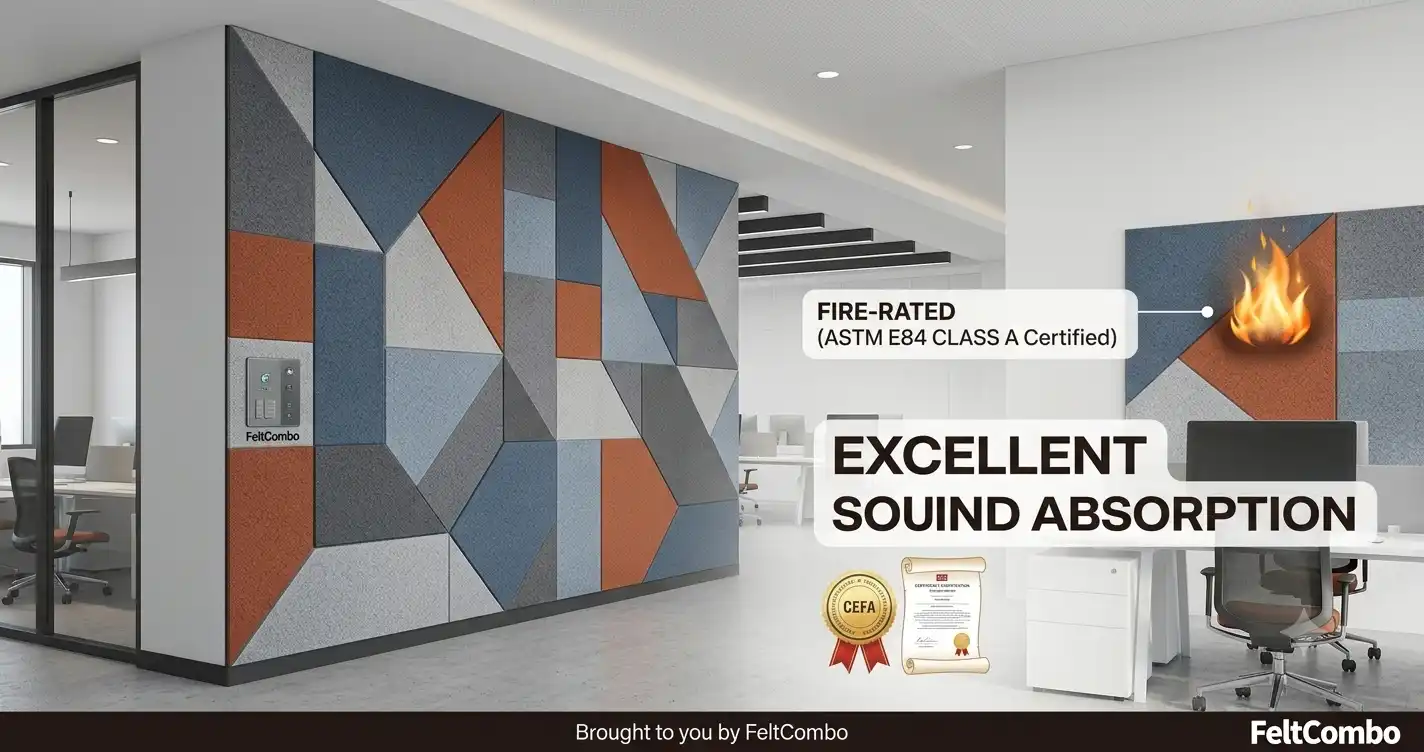
Fire-Rated PET Acoustic Panels: Understanding Class A Compliance for US & International Projects in 2026
I am going to be straightforward with you. If you are sourcing acoustic panels for a commercial project in the United States — a hotel, an office building, a hospital, a retail centre, a school — fire rating is not a value-add feature you consider after pricing. It is the first filter. It determines whether the product can legally be installed in the space at all. Everything else — colour, NRC value, aesthetics, lead time — comes after that question is resolved.
The reason I am writing this article is that I talk to buyers every month who have been burned — sometimes literally in terms of project delay and financial exposure — by suppliers who presented certificates that did not hold up under scrutiny. A PDF certificate is not the same as a verifiable test report from an accredited laboratory. A self-declaration is not the same as a third-party certification. And a certificate issued for one product specification does not automatically cover a different thickness, density, or surface treatment of the same base material.
Feltcombo holds ASTM E84 Class A certification, EN13501-1 Class B, BS476-1 Class 1, and AS ISO 9705 Group 1. We can provide original laboratory test reports. Our certifications are issued against specific product formulations, and we re-test when formulations change. This article will explain what those certifications mean, how to verify any supplier's claims — including ours — and how to make sure the product you specify is actually the product that gets tested and delivered.
📋 Table of Contents
Why Fire Rating Is Non-Negotiable for Commercial Acoustic Panels
In residential construction, fire rating requirements for interior finish materials are relatively lenient in most jurisdictions. That changes dramatically when you enter commercial occupancy categories. The International Building Code (IBC), which is adopted in some form across all 50 US states, sets interior finish flame spread requirements based on occupancy type and sprinkler status. For assembly spaces (A-1 through A-5), educational facilities (E), and business occupancies (B) — the very categories where acoustic treatment is most commonly specified — the requirements for wall and ceiling finish materials range from Class A to Class B under ASTM E84.
In practice, for any commercial project involving a licensed architect, a code-compliant specification review, and a building inspection process, acoustic panels that cannot demonstrate ASTM E84 Class A or Class B compliance will not pass inspection. Full stop. And increasingly, owners and general contractors are requiring Class A — not just Class B — as the default specification to reduce liability and simplify the approval process.
This is not unique to the US. The UK's Building Regulations Part B, the EU's Construction Products Regulation (CPR), and Australia's National Construction Code all have analogous requirements. The specific standards differ — EN13501, BS476, AS ISO 9705 — but the principle is identical: interior finish materials in commercial spaces must meet documented, third-party verified fire performance thresholds.
Where this creates a supply chain problem is straightforward: the global market for PET acoustic panels has expanded rapidly over the past decade, and a large proportion of suppliers — particularly those entering the market recently — have not invested in genuine third-party certification. They may have a certificate of some kind. But whether that certificate covers the specific product being sold, whether the issuing laboratory is accredited, and whether the test was conducted on the same formulation as the delivered product, are three separate questions with separate answers.
I have seen projects delayed by weeks because a contractor arrived on site with panels whose certificates did not survive a fire marshal review. I have seen projects where substitution with a compliant product had to happen at short notice, at significant cost. These are avoidable outcomes — but only if the compliance verification happens at the sourcing stage, not at the installation stage.
💡 Practical Take for Procurement Teams
Make fire certification verification part of your supplier pre-qualification process, not your submittal review process. By the time submittals are under review, lead times are already committed. If a supplier cannot provide an original laboratory test report — not a certificate summary, but the actual detailed test report from the accredited testing facility — within 48 hours of request, that is a meaningful signal about their certification posture. Treat it accordingly.
ASTM E84 Explained: Flame Spread & Smoke Development Index
ASTM E84 is the standard test method for surface burning characteristics of building materials, published by ASTM International. It is sometimes referred to as the "tunnel test" because the test apparatus — the Steiner Tunnel — is a 25-foot horizontal tunnel in which a sample is exposed to a controlled flame at one end, and the spread of the flame along the surface and the smoke density generated are both measured over a 10-minute period.
The test produces two index values:
Flame Spread Index (FSI) — A numerical score representing how quickly flame travels along the surface relative to a reference material (red oak = 100). A lower FSI indicates less surface flame propagation.
Smoke Developed Index (SDI) — A numerical score representing the quantity of smoke generated during the test. A lower SDI indicates less smoke production.
The three ASTM E84 classification levels relevant to commercial specification are:
| Class | Flame Spread Index (FSI) | Smoke Developed Index (SDI) | Typical IBC Application |
|---|---|---|---|
| Class A (I) | 0 – 25 | 0 – 450 | Exitways, high-risk assembly occupancies, corridors |
| Class B (II) | 26 – 75 | 0 – 450 | Rooms in sprinklered assembly & educational buildings |
| Class C (III) | 76 – 200 | 0 – 450 | Low-risk occupancies, residential (limited commercial use) |
* SDI limit of 450 applies uniformly across all three classes. Source: ASTM E84 / IBC Section 803.
Feltcombo's PET acoustic panels at 9mm / 1800gsm achieve ASTM E84 Class A — FSI ≤ 25 and SDI ≤ 450. This is the highest fire classification under ASTM E84 and is accepted for all commercial interior finish applications in IBC-governed jurisdictions without further restriction.
One technical point that is worth understanding: the SDI threshold of 450 is the same across Class A, B, and C. This means that smoke production — not just flame spread — is independently constrained. A material that achieves low FSI but generates dense smoke would still fail to reach Class A. PET fibre, when formulated with appropriate flame retardant chemistry, performs well on both indices. The flame retardant treatment suppresses both surface flame propagation and the combustion reactions that generate smoke.
A second point: ASTM E84 test results are tied to the specific sample tested. If a manufacturer changes the resin binder, the fibre density, the surface coating, or the thickness of the panel, the previously issued ASTM E84 certificate no longer applies. This is not a technicality — it is a fundamental aspect of how the standard works. Any supplier who cannot tell you which specific formulation their ASTM certificate applies to is either uninformed about their own product or being imprecise in a way that should concern you.
💡 What to Ask Any Supplier About Their ASTM E84 Certification
Ask for the test report — not just the certificate — and check three things: (1) the name of the testing laboratory and whether it is accredited by a recognised body such as IAS or A2LA; (2) the exact product description in the report — thickness, density (gsm), and any surface treatment; (3) the test date. A report more than 5 years old for an actively changing product line deserves a follow-up question about whether the formulation has changed since testing.
EN13501-1 Class B vs. Class A: What's the Difference?
The European fire classification system operates under EN13501-1, which classifies construction products using a letter-based reaction-to-fire system: A1, A2, B, C, D, E, F — running from non-combustible (A1) to no performance determined (F). Unlike ASTM E84's tunnel test, EN13501-1 draws on results from multiple tests, primarily the Single Burning Item (SBI) test (EN13823) for Classes A2 through D, and the ignitability test (EN ISO 11925-2) as a secondary criterion.
For PET acoustic panels, the practically relevant classifications are:
EN13501-1 Class A2 — Limited combustibility. Typically requires materials with low organic content. PET fibre, being a polymer-based material, does not naturally achieve A2 classification without exceptional flame retardant formulations. In practice, very few PET panel manufacturers hold Class A2.
EN13501-1 Class B — Very limited contribution to fire. This is the standard that high-quality flame-retardant PET panels can achieve with a well-engineered formulation and is accepted for commercial interior applications across EU member states and many other markets that reference Euroclass ratings. Feltcombo's PET panels at 9mm / 1800gsm hold Class B.
EN13501-1 Class C — Limited contribution to fire. This is acceptable for some commercial applications in some jurisdictions but does not meet the specification requirements for high-occupancy or high-risk spaces in the EU regulatory framework.
A common source of confusion in North American procurement is the mapping between ASTM E84 Class A and EN13501 Class A. These are not the same classification system, and the letter designations do not correspond directly. ASTM E84 Class A is broadly comparable to EN13501 Class B in terms of the risk level addressed — both represent the threshold for high-occupancy commercial interior applications. EN13501 Class A1/A2 represents a higher bar (non- or limited-combustibility) that most organic materials, including high-performance PET, do not meet.
For projects that need to satisfy both US and European fire requirements — international hotel chains, multinational corporate campuses, globally tendered projects — Feltcombo's dual ASTM E84 Class A and EN13501 Class B certification covers both jurisdictions from a single product supply. This avoids the operational complexity of sourcing different certified products for different markets.
| EN13501-1 Class | Description | Primary Test Method | Achievable by PET Panels? |
|---|---|---|---|
| A1 | Non-combustible | EN ISO 1182 + EN ISO 1716 | No (polymer-based materials excluded) |
| A2 | Limited combustibility | EN13823 (SBI) + EN ISO 1182 | Rare; exceptional formulations only |
| B | Very limited fire contribution | EN13823 (SBI) + EN ISO 11925-2 | Yes — Feltcombo 9mm 1800gsm certified |
| C | Limited fire contribution | EN13823 (SBI) + EN ISO 11925-2 | Yes — standard FR formulation |
| D / E / F | Acceptable / Poor / No performance | EN ISO 11925-2 / None | Not suitable for commercial use |
BS476-1 Class 1: Requirements for UK Specifications
British Standard BS476 is the UK's legacy fire test framework for building materials, developed and published by the British Standards Institution. Part 7 of BS476 — "Method of test to determine the classification of the surface spread of flame of products" — classifies materials into four classes based on how far flame spreads across the surface under defined test conditions.
BS476 Part 7 classifications run from Class 1 (best performance — least surface flame spread) to Class 4 (highest flame spread, no commercial application). For UK commercial interior specifications, Class 1 is the standard required for wall and ceiling linings in offices, hotels, retail spaces, and all other non-domestic buildings under Approved Document B of the Building Regulations.
Feltcombo's PET panels at 12mm achieve BS476-1 Class 1. This is significant for any buyer sourcing for UK projects, or for markets that reference BS standards — including Hong Kong, Singapore, parts of the Middle East, and several Commonwealth countries whose building regulations historically followed the British framework.
A note on the relationship between BS476 and EN13501: following the UK's departure from the EU, the Approved Document B guidance was updated to accept both BS476 classifications and Euroclass EN13501 ratings for compliance purposes. In practice, for new projects, specifiers increasingly use EN13501 because it provides finer discrimination between performance levels and aligns with European product documentation. However, for renovation projects in existing buildings where the original specification references BS476, or for procurement programmes that span both UK and Commonwealth markets, BS476 Class 1 certification remains the required document.
💡 UK & Middle East Specifiers: Check Which Standard Your BCO Requires
In the UK, Building Control Officers (BCOs) will accept either BS476 Class 1 or EN13501 Class B for most wall lining applications in commercial buildings. In the Middle East — particularly UAE, Saudi Arabia, Qatar — local civil defence fire codes frequently reference BS standards rather than Euroclass, even for recent projects. Always confirm with the relevant authority having jurisdiction (AHJ) before finalising your specification. Feltcombo can provide documentation under both systems.
Feltcombo's Complete Certification Portfolio (ASTM E84 Class A / EN13501 Class B / BS476 / AS ISO 9705)
The table below is a definitive summary of Feltcombo's current fire certification holdings for PET acoustic panels. I want to be clear about what this table shows and, just as importantly, what it does not show.
What it shows: the certifications we currently hold, the specific product parameters those certifications apply to, and the markets they are relevant for.
What it does not show: certifications that apply to all products across all thicknesses and densities. No manufacturer's single certificate covers every product variant. If you need certification for a product configuration not listed here — a different thickness, a different density, a custom colour — the right answer is to ask us directly about the applicable certification pathway, not to assume coverage extends automatically.
| Certification Standard | Classification | Product Specification | Market Relevance | Original Report Available |
|---|---|---|---|---|
| ASTM E84 | Class A | PET 9mm / 1800gsm | USA, Canada | ✅ Yes |
| EN 13501-1 | Class B | PET 9mm / 1800gsm | EU, UK (harmonised) | ✅ Yes |
| BS 476 Part 7 | Class 1 | PET 12mm | UK, Middle East, HK, Singapore | ✅ Yes |
| AS ISO 9705 | Group 1 | PET 9mm / 1500gsm | Australia, New Zealand | ✅ Yes |
| AS NZS 1859 | Pass | Wood Slat Panel (MDF substrate) | Australia, New Zealand | ✅ Yes |
| EN 13986 | Pass | MDF (Wood Slat Panel substrate) | EU, UK | ✅ Yes |
| GRS (Global Recycled Standard) | Certified | PET range (min. 50% recycled content) | Global (LEED / BREEAM / ESG) | ✅ Yes |
On the GRS certification: I include this in a fire certification article because for many commercial projects in 2026 — particularly hotel and corporate real estate development with ESG reporting requirements — GRS certification is evaluated alongside fire certification in the supplier qualification process. Our PET panels contain a minimum of 50% recycled PET, and the GRS certificate provides the chain-of-custody documentation needed for LEED v4.1 Material and Resources credits and BREEAM Mat category submissions.
How to Verify a Manufacturer's Fire Certification (Red Flags to Avoid)
This is the section of the article I wish more procurement teams read before issuing purchase orders rather than after. The following is based on situations I have encountered in real sourcing conversations, not hypothetical scenarios.
Green Flags: What Good Certification Documentation Looks Like
Original laboratory test report, not just a certificate summary. A valid test report runs multiple pages. It includes the laboratory's letterhead, the test date, the exact sample description (material, thickness, density, dimensions), the test method applied, the raw test measurements, and the final classification result. A one-page certificate summary with no underlying report is not independently verifiable.
Named, accredited testing laboratory. For ASTM E84, the testing must be conducted by a laboratory accredited by a body recognised by the International Laboratory Accreditation Cooperation (ILAC). In the US, common accrediting bodies include IAS (International Accreditation Service) and A2LA (American Association for Laboratory Accreditation). The laboratory's accreditation should be verifiable on the accrediting body's public database.
Product description that matches what you are buying. The test report should describe a product that is consistent with what is being quoted: same base material (PET), same thickness (e.g. 9mm), same density (e.g. 1800gsm), and ideally same surface treatment. If you are buying 9mm plain panel and the certificate is for a 12mm carved panel, those are not the same product and the certificate does not apply.
Test date within a reasonable window and formulation confirmation. Ask the supplier whether the product formulation has changed since the test date. A certificate that is 7 years old is not automatically invalid — PET formulations are often stable over long periods — but it warrants a direct question about whether any changes to the flame retardant chemistry, fibre supplier, or processing conditions have occurred in the interim.
Red Flags: Patterns That Should Give You Pause
"We have certifications" with no documents provided. This is the most common evasion. Any supplier with genuine certifications can send them within 24 hours. Delay is not a workflow issue — it is either an organisation problem or a document problem. Neither is reassuring.
Certificate issued in Chinese with no accredited translation, or from an unrecognised Chinese testing body. China has excellent CNAS-accredited testing laboratories (CNAS is a member body of ILAC). However, there are also many domestic Chinese quality certificates that are not recognised under ASTM, Euroclass, or BS frameworks. A certificate that references only a Chinese national standard (GB) does not constitute ASTM E84 compliance. These are separate tests.
Certificates that describe a different thickness or product than what is in the quotation. This is surprisingly common. A supplier holds a Class A certificate for their 9mm panel and presents it as coverage for their 12mm or 24mm product. Ask directly: "Is this certificate for the exact product in your quotation?"
Inability to name the testing laboratory. If a supplier cannot immediately tell you which laboratory conducted their fire tests, that is worth investigating further. Legitimate certifications have a named laboratory on the document.
Certificates for composite products where the facing material is the variable. If a supplier tests a plain PET panel and then sells carved, printed, or wood-veneer-faced versions using the same certificate, ask whether those surface treatments were included in the test sample or tested separately. Surface treatments — particularly printed coatings — can affect both FSI and SDI. A responsible manufacturer tests representative samples of each product configuration sold under a fire classification.
💡 How Feltcombo Handles This
When a client requests fire certification documentation from Feltcombo, we provide the full original test report in PDF — not a summary certificate. The report includes the laboratory name, accreditation details, sample description, and test data. We also state clearly which product the certificate applies to and flag if the enquired product differs from the certified sample. If a project requires a specific certification that we do not currently hold for a requested product configuration, we say so and, where feasible, we discuss whether project-volume justifies additional testing. Transparency about certification scope is a basic professional responsibility.
Which Feltcombo Products Carry Which Certifications?
The following matrix maps Feltcombo's product lines to applicable fire and sustainability certifications. Use this as a reference when reviewing a specification and deciding which product line to enquire about.
| Product Line | ASTM E84 Class A | EN13501 Class B | BS476 Class 1 | AS ISO 9705 Gr.1 | GRS |
|---|---|---|---|---|---|
| Plain PET Acoustic Panels (9mm / 1800gsm) | ✅ | ✅ | — | — | ✅ |
| Plain PET Acoustic Panels (9mm / 1500gsm) | — | — | — | ✅ | ✅ |
| Plain PET Acoustic Panels (12mm) | — | — | ✅ | — | ✅ |
| Carved PET Acoustic Panels | ⚠ Confirm at enquiry | ⚠ Confirm at enquiry | ⚠ Confirm at enquiry | ⚠ Confirm at enquiry | ✅ |
| Embossed PET Acoustic Panels | ⚠ Confirm at enquiry | ⚠ Confirm at enquiry | — | — | ✅ |
| Printed PET Acoustic Panels | ⚠ Confirm at enquiry | ⚠ Confirm at enquiry | — | — | ✅ |
| 24mm PET Acoustic Panels | ⚠ Confirm at enquiry | ⚠ Confirm at enquiry | ⚠ Confirm at enquiry | ⚠ Confirm at enquiry | ✅ |
| Wood Veneer PET Acoustic Panels | ⚠ Confirm at enquiry | ⚠ Confirm at enquiry | — | — | ✅ |
| Acoustic Wood Slat Panels (MDF substrate) | — | — | — | — | — |
✅ = Certification currently held for this product configuration. ⚠ = Certification pathway available; confirm specific product details at enquiry stage. — = Not applicable or not currently held. Contact Feltcombo for the most current certification status.
I want to draw specific attention to the "Confirm at enquiry" entries. These are not evasions — they reflect the genuine complexity of fire certification applied to product ranges with multiple configurations. A plain 9mm panel with 1800gsm density that has been ASTM-tested is not the same product as a printed 9mm panel with a UV coating layer. The base substrate may be identical, but the surface treatment adds a variable that the test did not evaluate. For most standard commercial projects, the plain panel certification is sufficient for submittal purposes. For projects where the fire marshal or specification authority requires certification of the exact installed product configuration, we discuss testing options at the project level.
Requesting Certification Documents & Test Reports
This is the practical end of the article. You know what certifications exist, what they mean, and how to evaluate a supplier's claims. Now, how do you actually get the documents from Feltcombo for your specific project?
Standard Certification Pack
For any enquiry involving a commercial project, Feltcombo provides a standard certification pack at no charge upon request. This includes:
ASTM E84 test report (original, from accredited US laboratory) — for 9mm / 1800gsm PET panels
EN13501-1 Class B declaration of performance and supporting test data
BS476 Part 7 Class 1 test report — for 12mm panels
AS ISO 9705 Group 1 test report — for 9mm / 1500gsm panels (Australia enquiries)
GRS certificate (current valid certificate with chain-of-custody scope)
Project-Specific Certification Submissions
For projects that require documentation in a specific format — such as formatted submittal packages for US general contractors, DoP (Declaration of Performance) format for EU CPR compliance, or CE marking documentation — we can prepare project-specific packages. These take 3–5 business days to compile properly. Please provide the project name, destination jurisdiction, specifying architect or acoustic consultant name, and the specific certification standards required when making this request.
For Specifications That Reference a Non-Standard Format
Occasionally, projects — particularly in the Middle East, Southeast Asia, or custom-requirement markets — reference fire testing standards that do not map directly to our current certification portfolio. Where this happens, we advise on the closest equivalent we hold and flag any gap clearly. We do not present a certificate as covering a standard it was not tested against. If additional testing is required and the project volume justifies it, we discuss options including arranging supplementary testing through our laboratory partners.
How to Request
Email info@feltcombo.com with the subject line "Certification Request — [Project Name / Market]". Include the product specification you are evaluating (thickness, density, surface finish if relevant) and the standard(s) required. Our standard response time for certification documentation requests is 48 hours on business days. For urgent project deadlines, state the date by which you need the documents and we will prioritise accordingly.
Phone: +86 512 6728 5061 | Address: No. 108 Yunhui Road, Industrial Park, Suzhou 215000, China
Frequently Asked Questions: Fire-Rated PET Acoustic Panels
Q: Does Feltcombo hold ASTM E84 Class A certification for PET acoustic panels?
Yes. Feltcombo's PET acoustic panels at 9mm / 1800gsm carry ASTM E84 Class A certification (FSI ≤ 25, SDI ≤ 450). The original test report from an accredited laboratory is available upon request for project submission purposes.
Q: Is ASTM E84 Class A required for all commercial acoustic panel installations in the US?
It depends on occupancy type, sprinkler status, and which IBC table applies to the specific space. Class A is required for exitways and some assembly occupancies. Class B may be accepted for rooms within sprinklered buildings in other occupancy categories. We recommend confirming with the project's licensed architect or AHJ for the specific requirement. When in doubt, specifying Class A eliminates ambiguity.
Q: Is EN13501-1 Class B equivalent to ASTM E84 Class A?
They are not the same test or classification system, but both represent the standard for high-occupancy commercial interior applications in their respective jurisdictions. ASTM E84 Class A is used in North America; EN13501 Class B is the Euroclass equivalent. They are tested by different methods. For projects requiring compliance in both regions, both certificates are needed separately.
Q: Can Feltcombo provide fire certification for custom colours and surface treatments?
Our certifications are held for specific product formulations — primarily plain panels at defined thickness and density. For custom-colour or printed panels, most projects are accepted under the base substrate certification. Where a specific project requires certification of the exact installed finish, we discuss additional testing options. Contact us with your specification details.
Q: How do I verify that a Feltcombo fire certificate is genuine?
Request the original test report (not just a certificate summary) and check the named laboratory against its accrediting body's public database. For ASTM reports, the laboratory should be IAS or A2LA accredited. You can search these databases online. Feltcombo will provide full test reports — not summaries — and can confirm the laboratory details for any certificate in our portfolio.
Q: Does fire certification from a Chinese factory apply to products delivered to the US?
The ASTM E84 test standard is recognised regardless of where the manufacturing facility is located — what matters is that the test was conducted by an accredited laboratory using the specified ASTM E84 test method. Feltcombo's ASTM E84 certification was obtained through an accredited laboratory and is accepted for US commercial project submittals. Origin country is not a determining factor for ASTM compliance.
Need Fire-Certified PET Acoustic Panels for Your Project?
ASTM E84 Class A · EN13501-B · BS476 Class 1 · AS ISO 9705 Group 1 | Original test reports available | China & Thailand factory-direct
Mr. Xiao — Acoustic Materials Specialist
Feltcombo | Suzhou, China | Updated 2026
Mr. Xiao has over 10 years of experience in PET acoustic panel production, fire compliance documentation, and international project supply across 24+ countries. He regularly works with acoustic consultants, architects, and procurement teams to navigate fire certification requirements for commercial projects in North America, Europe, Australia, and the Middle East. His focus is on ensuring that certification documentation matches project specifications before materials leave the factory — not after they arrive on site.
References & Standards
ASTM E84-21 — Standard Test Method for Surface Burning Characteristics of Building Materials (ASTM International, West Conshohocken, PA)
International Building Code (IBC) 2021 — Section 803: Wall and Ceiling Finish Materials (International Code Council)
EN 13501-1:2018 — Fire Classification of Construction Products and Building Elements — Part 1: Classification Using Data from Reaction to Fire Tests (European Committee for Standardisation, CEN)
EN 13823:2020 — Reaction to Fire Tests for Building Products — Building Products Excluding Floorings Exposed to the Thermal Attack by a Single Burning Item (SBI) (CEN)
BS 476 Part 7:1997 — Fire Tests on Building Materials and Structures: Method of Test to Determine the Classification of the Surface Spread of Flame of Products (British Standards Institution)
AS ISO 9705:2003 — Fire Tests — Full-Scale Room Test for Surface Products (Standards Australia)
GRS (Global Recycled Standard) v4.0 — Textile Exchange / Control Union Certifications
UK Building Regulations Approved Document B (Fire Safety) — Volume 2: Buildings Other Than Dwellings, 2022 Edition (UK Government / MHCLG)
IAS (International Accreditation Service) — Laboratory Accreditation Programme: www.iasonline.org
Feltcombo Official Website — Certification & Product Information: https://www.feltcombo.com/
Related News
Read More >-
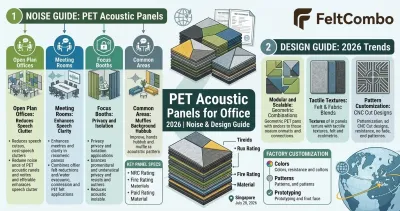
![PET Acoustic Panels for Office 2026 | Noise & Design Guide]()
PET Acoustic Panels for Office 2026 | Noise & Design Guide
Fix open office noise in 2026 with PET acoustic panels. 100+ colors, ASTM E84 Class A, easy install. Feltcombo: factory-direct from China & Thailand. Free consultation.
-
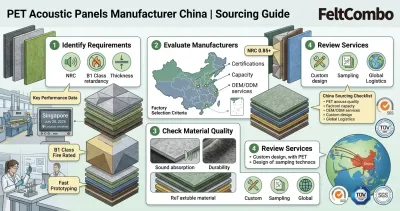
![PET Acoustic Panels Manufacturer China | 2026 Sourcing Guide]()
PET Acoustic Panels Manufacturer China | 2026 Sourcing Guide
How to choose a reliable PET acoustic panel factory in China. ASTM E84, EN13501 & GRS certified. Feltcombo: 3 China bases + Thailand, 10 years experience, 24+ countries.
-
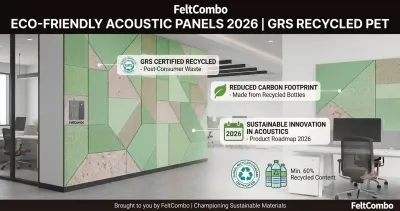
![Eco-Friendly Acoustic Panels 2026 | GRS Recycled PET]()
Eco-Friendly Acoustic Panels 2026 | GRS Recycled PET
Feltcombo's GRS-certified PET acoustic panels use ≥50% recycled content and are recyclable after use. Support LEED & BREEAM credits. Factory-direct, full sustainability documentation.
-
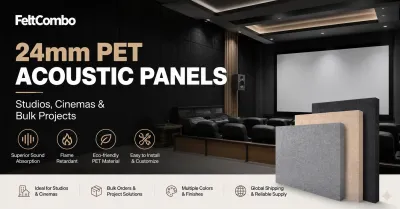
![24mm PET Acoustic Panels | Studios, Cinemas & Bulk Projects]()
24mm PET Acoustic Panels | Studios, Cinemas & Bulk Projects
Source 24mm PET acoustic panels from Feltcombo's China & Thailand factories. Custom sizes, Class A fire rating, verified NRC data, and stable bulk supply for high-spec projects.
-
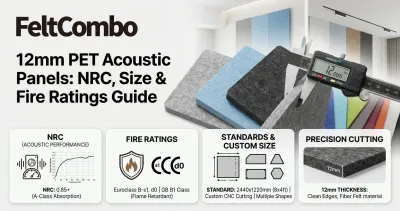
![12mm PET Acoustic Panels: NRC, Size & Fire Ratings Guide 2026]()
12mm PET Acoustic Panels: NRC, Size & Fire Ratings Guide 2026
Specify 12mm PET acoustic panels with confidence — NRC performance vs 9mm, 1225×2850mm format, BS476 Class 1 update, 59 stock colors, and China & Thailand factory supply explained for B2B buyers.
-
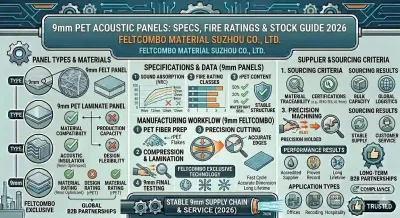
![9mm PET Acoustic Panels: Specs, Fire Ratings & Stock Guide 2026]()
9mm PET Acoustic Panels: Specs, Fire Ratings & Stock Guide 2026
Everything B2B buyers need on 9mm PET acoustic panels — 1500 vs 1800gsm, ASTM E84 Class A & EN13501 Class B fire ratings, 39 stock colors, and China vs Thailand factory quality explained.
-
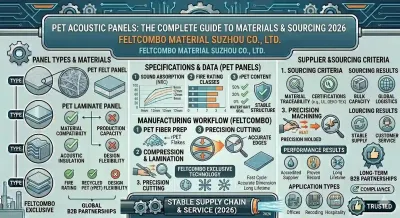
![PET Acoustic Panels: The Complete Guide to Materials & Sourcing 2026]()
PET Acoustic Panels: The Complete Guide to Materials & Sourcing 2026
Everything B2B buyers need to know about PET acoustic panels in 2026 — NRC ratings, fire certifications (ASTM E84/EN13501), eco credentials, and how to source from a certified China & Thailand manufacturer.
-
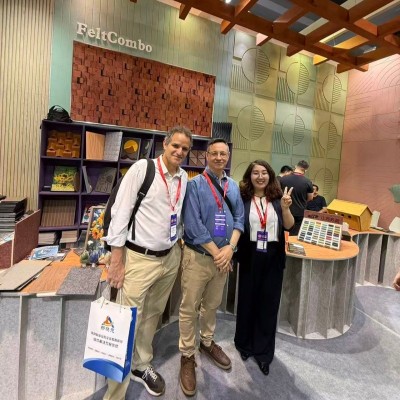
![FeltCombo Presents High-Performance, Sustainable Acoustic Systems at CIFF Guangzhou 2026]()
FeltCombo Presents High-Performance, Sustainable Acoustic Systems at CIFF Guangzhou 2026
FeltCombo Presents High-Performance, Sustainable Acoustic Systems at CIFF Guangzhou 2026