


Eco-Friendly Acoustic Panels 2026 | GRS Recycled PET
2026-06-28 15:18

Written by Mr. Xiao — Acoustic Materials Specialist, Feltcombo
10+ years in sustainable PET acoustic panel production & global green building supply | Updated: 2026
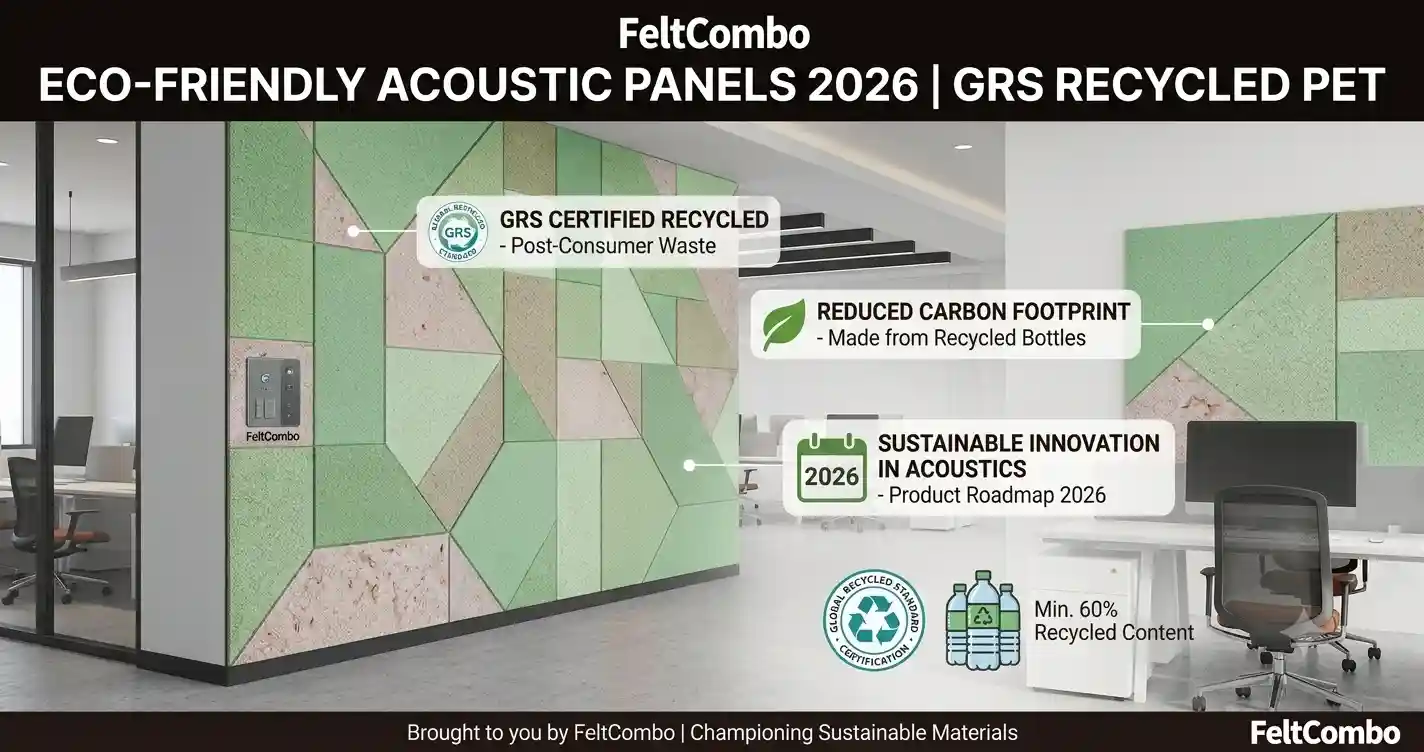
Eco-Friendly Acoustic Panels in 2026: Why GRS-Certified Recycled PET Is the Sustainable Choice for Green Buildings
There is a version of "eco-friendly" that is mostly marketing. You have seen it: a product with a green leaf on the packaging, a vague claim about being "environmentally conscious," and no documentation behind any of it. Procurement teams and green building consultants in 2026 are rightly exhausted by this. The bar for what constitutes credible sustainability in construction materials has risen sharply, and it should have.
This article is not about green marketing. It is about a specific material — recycled PET acoustic panels — and a specific set of verifiable credentials that make them a genuinely defensible choice for projects targeting LEED, BREEAM, or internal ESG procurement standards. I will explain what GRS certification actually means and what it requires of a manufacturer, where PET panels sit in the broader lifecycle of building materials, and what documentation a procurement team or sustainability consultant needs to support a green building submission.
At Feltcombo, our PET acoustic panels contain a minimum of 50% recycled PET fibre, certified under the Global Recycled Standard. The panels are also recyclable at end of life — meaning the material loop does not close at the factory gate; it extends through the building's entire useful life and beyond. That is not a claim we make in a brochure and then quietly cannot document. We hold the certificates, and this article will explain what they mean.
📋 Table of Contents
The Environmental Impact of Traditional Acoustic Materials
Acoustic treatment has been a feature of commercial interiors for decades, but the dominant materials of the industry's earlier years — mineral wool, fibreglass batts, foam-based products, and vinyl-faced ceiling tiles — carry environmental profiles that are difficult to reconcile with modern sustainability standards. Understanding why matters, because it contextualises what "eco-friendly" actually requires an acoustic material to achieve.
Mineral Wool and Fibreglass
Both are energy-intensive to manufacture. The production of mineral wool involves melting basalt rock or slag at temperatures above 1,400°C. Fibreglass production requires similar high-temperature processes with silica sand as a primary input. Both materials present end-of-life challenges: they cannot be recycled through standard municipal waste streams, and landfill disposal is the typical outcome. Fibreglass, in particular, has documented health concerns related to respirable fibres during cutting and installation — a consideration that has driven many specifiers toward alternative materials for occupied spaces.
Foam-Based Acoustic Panels
Polyurethane and melamine foams are widely used in acoustic treatment, particularly in studios and broadcast environments. Their sustainability profile is poor. Polyurethane foam is derived from petrochemical feedstocks, has high embodied carbon relative to its acoustic contribution, and is essentially non-recyclable. Many foam acoustic products also contain flame retardant additives — historically including halogenated compounds — that present concerns under the EU's REACH regulation and equivalent frameworks. The EU's push toward a Circular Economy Action Plan has specifically targeted foam-based products as a priority for substitution.
Traditional Fabric-Wrapped Panels
The substrate beneath the fabric in most conventional acoustic panels is either fibreglass or mineral wool. The fabric facing — often a PET or polyester blend — adds a layer of material that complicates disassembly and recycling. At end of life, most fabric-wrapped panels are landfilled as composite waste, because separating the fabric from the substrate for separate material recovery is not economically viable at project scale.
Why This Matters for Specification in 2026
The EU's Level(s) framework, BREEAM Mat category requirements, LEED v4.1 Material and Resources credits, and an expanding number of corporate ESG procurement policies now require specifiers to consider embodied carbon, recycled content, and end-of-life recyclability as part of material selection — not as optional considerations but as scored, documented requirements. In this environment, specifying mineral wool or foam-based acoustic panels without evaluating alternatives is a decision that will increasingly need to be justified in writing.
💡 Practical Take for Green Building Consultants
When evaluating acoustic materials for a LEED or BREEAM submission in 2026, the three material attributes that generate the most credit-relevant documentation are: (1) recycled content percentage with third-party chain-of-custody certification, (2) absence of substances of very high concern (SVHCs) under REACH, and (3) a documented end-of-life recyclability pathway. A material that satisfies all three from a single certified source reduces both your submission workload and the risk of documentation gaps during audit.
What Makes PET Panels Eco-Friendly? (Recycled Content, End-of-Life Recyclability, No VOC, No Formaldehyde)
PET — polyethylene terephthalate — is the polymer used in plastic bottles, food-grade packaging, and polyester textiles. It is one of the most widely recycled thermoplastics in the world, with an established global collection and reprocessing infrastructure. When used as the raw fibre in acoustic panels, recycled PET (rPET) carries a set of environmental attributes that are genuinely differentiated from traditional acoustic substrates. Let me work through each one.
Recycled Content: Where the Fibre Comes From
The PET fibre in Feltcombo's acoustic panels is sourced from post-consumer recycled feedstock — primarily recovered plastic bottles that have been cleaned, shredded, melted, and extruded into fibre form. This is not pre-consumer industrial trim or production waste dressed up as "recycled content." Post-consumer recycled content is the material that would otherwise have entered a waste stream. Diverting it into a building product with a 20-to-30-year useful life is a meaningful carbon and waste outcome.
The minimum recycled content in Feltcombo's PET acoustic panels is 50% by weight. In practice, many batches exceed this. The 50% figure is the certified floor — the guaranteed minimum that GRS chain-of-custody documentation supports for every production run.
End-of-Life Recyclability
This is the dimension that most acoustic panel manufacturers either ignore or cannot address. Recyclability after use requires that the material can re-enter a recognised recycling stream at the end of its service life in the building. PET is a recyclable thermoplastic. When Feltcombo panels are removed from a building at end of life, the PET fibre can be processed by facilities equipped to handle PET — which are widely available across Europe, North America, and Australia. The material does not need to go to landfill. This closes a loop that mineral wool and foam-based products cannot close.
No VOC Emissions
Volatile organic compound (VOC) emissions from interior building materials are a documented indoor air quality concern, addressed by standards including GREENGUARD, the EU's AgBB scheme, and LEED's EQ credit category. PET fibre panels do not contain solvent-based binders, adhesive coatings, or organic chemical treatments that off-gas VOCs. The base material is inert in normal ambient conditions. For WELL Building Standard projects and healthcare environments where indoor air quality is a primary design driver, the absence of VOC emissions is a meaningful specification criterion.
No Formaldehyde
Formaldehyde is a category 1 carcinogen under IARC classification and is regulated under the EU's REACH framework, California's CARB Phase 2 standard, and equivalent regulations in most developed markets. It is a common component of the binders and adhesives used in traditional fibreboard, MDF, and some mineral wool products. PET fibre acoustic panels do not use formaldehyde-containing binders. The manufacturing process bonds fibres through thermal fusion — heat and pressure, not chemical adhesives. This eliminates formaldehyde as a concern entirely for both installation workers and building occupants.
Mould and Moisture Resistance
PET fibre does not support mould growth. Unlike natural fibre acoustic products (wool, cotton, cellulose) and some mineral wool products installed in humid conditions, PET panels do not absorb moisture in a way that creates a substrate for microbial growth. This has both a health benefit — relevant for WELL and BREEAM Health & Wellbeing assessments — and a durability benefit, since mould damage is one of the primary causes of premature acoustic panel replacement and associated waste.
| Environmental Attribute | Recycled PET Panels | Mineral Wool | Polyurethane Foam | Fibreglass |
|---|---|---|---|---|
| Post-consumer recycled content | ≥50% (GRS certified) | Varies / low | None | Minimal |
| End-of-life recyclability | Yes — PET recycling stream | No — landfill typical | No — landfill typical | No — landfill typical |
| VOC emissions | None | Low / binder-dependent | Moderate to high | Low / binder-dependent |
| Formaldehyde-free | Yes | Binder-dependent | Generally yes | Binder-dependent |
| Mould resistant | Yes — inherently | Conditional | Conditional | Yes |
| Third-party sustainability cert | GRS (Feltcombo) | Varies by manufacturer | Rarely | Varies by manufacturer |
| LEED / BREEAM documentation available | Yes — full pack | Varies | Limited | Varies |
* Comparison based on typical market products. Individual manufacturer specifications may vary. Feltcombo data reflects certified product specifications as of 2026.
Understanding GRS Certification (Global Recycled Standard Explained)
The Global Recycled Standard (GRS) is an international, voluntary, full chain-of-custody standard that sets requirements for third-party certification of recycled content in a product. It was developed by Textile Exchange — an international non-profit with a focus on sustainable fibre and materials — and is currently one of the most widely recognised and rigorously audited recycled content standards applicable to PET fibre products.
GRS certification is not a self-declaration. It requires:
Third-party auditing — An accredited certification body (not the manufacturer itself) audits the supply chain from the recycled material source through each stage of processing and manufacturing to the finished product.
Chain-of-custody verification — Every step in the supply chain that handles the recycled material must be GRS-certified. A certificate held only by the end manufacturer does not cover the upstream supply chain; a genuine GRS certificate covers the entire documented chain from collection point to finished product.
Minimum recycled content threshold — GRS requires that a product contain a minimum of 20% recycled content to carry the certification. Products claiming GRS certification with specific recycled content percentages (such as ≥50%) must demonstrate that content level through the audited chain of custody.
Social and environmental requirements — Beyond recycled content, GRS also sets requirements for processing facilities on chemical use, wastewater management, workplace health and safety, and freedom of association. This means a GRS certificate is not only a material traceability document — it reflects a baseline of responsible manufacturing practice across the supply chain.
Annual renewal — GRS certificates require annual re-audit. A certificate that was issued two years ago and has not been renewed is not current and should not be accepted as evidence of present compliance.
For procurement teams and green building consultants, the practical significance of GRS certification is that it provides a single, internationally recognised document that substantiates a recycled content claim through verified chain-of-custody evidence. It is accepted by LEED v4.1 and BREEAM as supporting documentation for material credits. It can also be used to satisfy the recycled content requirements of corporate ESG procurement policies that specify third-party verified standards.
GRS vs. Other Recycled Content Claims
It is worth being clear about what GRS is not, because the market contains several lookalike claims that do not carry the same weight.
A manufacturer's own "recycled content" declaration without third-party certification is a self-reported claim with no independent verification. It is not equivalent to GRS and should not be treated as equivalent for LEED or BREEAM submissions.
ISO 14021 "recycled content" claims — ISO 14021 sets general principles for environmental claims on products, but it does not require third-party certification. A product can carry an ISO 14021 recycled content claim based solely on manufacturer self-assessment.
RCS (Recycled Claim Standard) — Also administered by Textile Exchange, RCS is a simpler standard that covers recycled content claims but does not include the social and environmental requirements of GRS. For projects where the full GRS standard is specified, RCS alone does not satisfy the requirement.
💡 Pro Tip: Checking a GRS Certificate's Validity
GRS certificates include a certificate number and the name of the issuing certification body. You can verify the certificate's current validity by contacting the certification body directly or — for certificates issued by Control Union, Bureau Veritas, or SGS — by searching their online certificate databases. Always request the current certificate (valid within the last 12 months) and check that the certified scope includes the specific product being purchased, not just the company name. A company can hold GRS certification for one product line while producing uncertified products under the same brand.
Feltcombo's Sustainability Credentials: ≥50% Recycled PET + GRS Certified
Let me put our own position on the table clearly, because that is what this section is for.
Feltcombo's PET acoustic panels are manufactured using a minimum of 50% post-consumer recycled PET fibre. Our GRS certification covers the chain of custody from our raw material suppliers through our manufacturing facilities in Jiangsu, Guangdong, and Thailand. The certificate is maintained through annual audit by an accredited third-party certification body and is available in full to any buyer who requests it for a project submission.
The 50% figure is a floor, not a ceiling. Our sourcing team works with raw material suppliers who are themselves GRS-certified, which means the chain-of-custody documentation extends back to the point at which the recycled PET was collected and processed. For a buyer who needs to demonstrate the traceability of recycled content for a LEED v4.1 MR credit or a BREEAM Mat category submission, this is the level of documentation the standard requires — and it is what we provide.
What Our GRS Certification Covers
Product scope: PET acoustic panel range — including plain, carved, embossed, printed, and 3D surface variants produced on our PET production lines.
Manufacturing locations: Our GRS certification covers production facilities across our China manufacturing bases. Thailand facility certification status should be confirmed at enquiry stage for project-specific documentation requirements.
Minimum recycled content: ≥50% post-consumer recycled PET by weight of the base panel material.
Scope of certification: Covers material sourcing, production, and final product. Does not extend to third-party distributors unless those parties are independently GRS-certified within the chain of custody.
Our Production Context
Feltcombo has been manufacturing PET acoustic panels since 2009. Our 12 production lines for PET panels — four of which were engineered in Germany — process recycled PET fibre using a thermal bonding process. No chemical binders are used in the core panel production. The thermal bonding process fuses PET fibres under controlled heat and pressure, which is both the reason the panels are formaldehyde-free and the reason the base material can be recycled at end of life without chemical separation steps.
Our combined manufacturing footprint across China and Thailand is 32,000m². We have supplied to projects in 24+ countries. The scale of our production relative to our GRS certification means that the certification is not a boutique credential applied to a small batch — it covers our standard production programme at commercial volume.
Contributing to LEED & BREEAM Credits with Acoustic Panels
Green building rating systems do not award credits simply for using a product that describes itself as sustainable. They require specific, documented evidence that a material meets defined criteria. The following is a practical breakdown of where recycled PET acoustic panels — specifically GRS-certified panels with verifiable recycled content — contribute to LEED v4.1 and BREEAM 2018/2023 credit structures.
LEED v4.1: Relevant Credit Categories
MR Credit: Building Product Disclosure and Optimization — Sourcing of Raw Materials
This credit rewards projects that use products from manufacturers who have extracted, harvested, or recovered raw materials responsibly, with preference for products containing recycled content. GRS-certified products with documented post-consumer recycled content contribute directly to this credit. The LEED v4.1 framework accepts third-party verified recycled content certifications — GRS is explicitly compatible — as documentation for the 20% by cost threshold required for credit points.
MR Credit: Building Product Disclosure and Optimization — Material Ingredients
This credit rewards products that disclose their chemical ingredients and demonstrate the absence of substances of concern. Feltcombo's PET panels are formaldehyde-free, VOC-free, and produced without halogenated flame retardants in our standard formulations. A Health Product Declaration (HPD) or equivalent ingredient disclosure document supports this credit category. We can assist with HPD preparation for qualified projects.
EQ Credit: Low-Emitting Materials
LEED's EQ credit category includes requirements for interior finishes to meet VOC emission thresholds. As noted earlier, PET fibre panels do not off-gas VOCs under normal ambient conditions. For projects pursuing EQ credits, our panels are positioned to contribute to the Interior Walls and Ceilings category without requiring additional product treatment or third-party emission testing.
BREEAM 2018 / 2023: Relevant Credit Categories
Mat 01: Life Cycle Impacts
BREEAM's Mat 01 assesses the embodied environmental impact of building materials using lifecycle assessment (LCA) data. The use of recycled content materials reduces embodied carbon and primary resource depletion scores in the LCA model. For projects in the UK and Europe where BREEAM is the primary rating system, the combination of ≥50% recycled content and end-of-life recyclability positions PET panels favourably in Mat 01 assessments relative to virgin mineral wool or foam alternatives.
Mat 03: Responsible Sourcing of Materials
BREEAM's Mat 03 credit awards points for materials that carry recognised responsible sourcing certifications. GRS certification — covering chain-of-custody from post-consumer waste collection through manufacturing — is a relevant certification type for Mat 03 assessment. The assessor's guidance under BREEAM 2023 accepts independently verified recycled content standards for products where the relevant certification body is internationally recognised.
Hea 02: Indoor Air Quality
BREEAM's Hea 02 credit covers VOC emissions from interior finishes and requires compliance with the EU's AgBB testing framework or equivalent. PET fibre panels, being thermally bonded without solvent-based adhesives or coatings, are compatible with AgBB requirements. For European projects targeting BREEAM Excellent or Outstanding ratings, this is a relevant consideration in acoustic panel specification.
| Rating System | Credit Category | Relevant PET Panel Attribute | Documentation Required |
|---|---|---|---|
| LEED v4.1 | MR — Sourcing of Raw Materials | ≥50% post-consumer recycled PET, GRS certified | GRS certificate + recycled content declaration |
| LEED v4.1 | MR — Material Ingredients | Formaldehyde-free, no SVHCs, no halogenated FR | HPD or Declare label (available on request) |
| LEED v4.1 | EQ — Low-Emitting Materials | Zero VOC emissions | Manufacturer declaration / test report |
| BREEAM 2023 | Mat 01 — Life Cycle Impacts | Recycled content reduces embodied carbon & resource depletion | LCA data / EPD (available on request) |
| BREEAM 2023 | Mat 03 — Responsible Sourcing | GRS chain-of-custody certification | Current GRS certificate with scope confirmation |
| BREEAM 2023 | Hea 02 — Indoor Air Quality | No VOC emissions, AgBB compatible | VOC emission test report or declaration |
| WELL v2 | Feature 05 — Volatile Compounds | No VOC emissions, no formaldehyde | Manufacturer declaration / test data |
* Credit applicability depends on project-specific submission requirements and assessor interpretation. Feltcombo can provide supporting documentation for each category listed. Confirm with your LEED AP or BREEAM assessor for project-specific guidance.
💡 For LEED APs and BREEAM Assessors
When preparing a material credit submission that includes PET acoustic panels, request the following documentation pack from your supplier upfront: (1) current GRS certificate with scope listing the specific panel product, (2) recycled content percentage declaration signed by an authorised company representative, (3) manufacturer's VOC emission declaration or third-party test report, (4) formaldehyde content declaration, and (5) end-of-life recyclability statement. Feltcombo prepares all five documents as a standard sustainability pack, available within 3 business days of request.
Cradle-to-Cradle Approach: Recyclable After Use
The term "cradle-to-cradle" gets used a lot in sustainable building discourse. Not all products that carry the label actually deliver on it. The concept, in its meaningful form, requires that a material can re-enter a productive material cycle at the end of its useful life — that its "end of life" is actually the beginning of a new material life, rather than a terminal disposal event. For this to be real rather than rhetorical, two conditions must be met: the material must be technically recyclable, and a practical recycling pathway must exist at relevant scale.
PET satisfies both conditions.
Technical Recyclability
PET is a thermoplastic — it can be melted and re-formed without degradation of its fundamental polymer chain. Unlike thermoset polymers (which cannot be remelted) or composite materials where multiple substances are chemically bonded, PET fibre panels do not contain irreversible material transformations. When a PET acoustic panel is removed from a building, the fibres can be shredded, melted, and re-extruded into new PET fibre or other PET products. The thermal bonding process used in Feltcombo's manufacturing — with no chemical binders — means there are no adhesive residues that complicate the recycling chemistry.
Practical Recycling Infrastructure
PET is the most widely recycled plastic in the world by volume. Recycling infrastructure for PET exists at commercial scale in Europe (EU PET recycling rates are consistently above 50%), North America, Australia, and across Asia. The material is accepted by post-industrial textile recycling operations and, in some markets, by municipal recycling programmes. For large commercial projects generating significant volumes of panel waste at end of building life, specialist textile and plastic recycling contractors can typically receive and process PET panel material. This is not a theoretical pathway — it is a currently operational material recovery route.
Why This Matters for ESG Reporting
Corporate ESG frameworks — GRI Standards, TCFD-aligned disclosures, EU Corporate Sustainability Reporting Directive (CSRD) requirements — increasingly require companies to account for circular economy metrics in their built environment. A building portfolio that can document the material recovery pathways for interior fit-out components at end of life is better positioned against circular economy reporting requirements than one that cannot. For corporate real estate teams managing large portfolios of office space, hotel rooms, or retail environments with planned refurbishment cycles, specifying recyclable acoustic panels from the outset creates a documented circular economy asset in their sustainability reporting — not just a procurement line item.
Durability as a Sustainability Factor
A material that lasts longer has lower lifecycle environmental impact per year of service. PET acoustic panels are inherently mould-resistant, dimensionally stable in normal interior humidity ranges, and not susceptible to the deterioration modes that affect natural fibre products. Under normal commercial interior conditions, a well-installed PET acoustic panel has a service life of 20–30 years without replacement. A product that needs replacement every 10 years has double the lifecycle material consumption, embodied carbon, and disposal burden of one that lasts 20. Durability is a sustainability argument that gets less attention than recycled content, but in lifecycle terms it is often the larger variable.
The Business Case for Sustainable Acoustic Panels in 2026
I want to address this section to the ESG-oriented corporate procurement audience specifically, because "the business case" is the question that turns sustainability interest into procurement action — and it deserves a direct answer rather than a collection of environmental statistics.
Regulatory Pressure Is Not Easing
The EU's Corporate Sustainability Reporting Directive (CSRD) came into full effect for large companies in 2025 and extends to SMEs on a phased schedule through 2026–2028. CSRD requires companies to report on how their business activities interact with sustainability issues — including the embodied environmental impact of their physical assets. For companies that own or manage significant real estate portfolios, interior fit-out materials are a visible component of the Scope 3 value chain emissions and material sustainability profile that CSRD reporting requires. Specifying materials with documented, third-party certified sustainability credentials is not just good practice — it is progressively becoming a reporting compliance matter.
Green Building Certification Adds Demonstrable Asset Value
Research across European and North American commercial real estate markets consistently shows a rent premium and occupancy advantage for LEED and BREEAM certified buildings over non-certified equivalents. The material specification decisions made during fit-out — including acoustic panel selection — contribute directly to whether a building achieves and maintains its certification status. For developers and asset managers, sustainable acoustic panels are a small cost item within the total project budget that contributes to a certification outcome with quantifiable commercial value.
Procurement Policy Alignment
An increasing number of large corporate occupiers — financial services firms, technology companies, professional services organisations — now publish sustainable procurement policies that specify requirements for recycled content, third-party verified certifications, and restricted substances in procurement decisions. For fit-out contractors and procurement teams supplying these occupiers, being able to evidence material compliance with their client's procurement policy is increasingly a condition of contract. GRS-certified, formaldehyde-free, recyclable acoustic panels are easier to justify within these policy frameworks than conventional alternatives.
The Cost Reality
I will not pretend that the sustainability attributes of PET acoustic panels are costless. GRS-certified, high-recycled-content panels carry a modest premium over uncertified commodity alternatives. In the context of a typical commercial fit-out budget, this premium is small — acoustic treatment is not a major cost line in most projects — but it is real. The business case calculation is: small material cost premium versus the value of green building certification credits, ESG reporting compliance, and client procurement policy alignment. For most commercial projects targeting LEED, BREEAM, or operating under a corporate sustainable procurement policy, this calculation is straightforward.
Supply Chain Transparency as Competitive Advantage
For architects, designers, and fit-out contractors who are building their own sustainability credentials in the market, being able to document the supply chain provenance of specified materials is increasingly a differentiator in competitive tender processes. Suppliers who can provide GRS certificates, recycled content declarations, VOC emission data, and end-of-life recyclability statements on demand are less friction in the specification and submittal process. This is a practical operational benefit that compounds over multiple projects.
💡 For Corporate Real Estate & ESG Teams
If your organisation publishes an annual sustainability report or is subject to CSRD disclosure requirements, the material specification decisions in your fit-out programme generate evidence that can directly support circular economy and responsible sourcing disclosures. Ask your fit-out contractor to document the recycled content and certification status of key interior materials — acoustic panels, flooring, wall linings — at the specification stage, not the handover stage. Retrofitting this documentation after the fact is substantially more difficult than capturing it during procurement.
Download Our Environmental Product Data Sheet
For projects requiring formal sustainability documentation — whether for a LEED submission, a BREEAM assessment, a corporate ESG procurement file, or an architect's specification support pack — Feltcombo provides a standard Environmental Product Data Sheet (EPDS) for our PET acoustic panel range.
The EPDS covers:
Material composition: PET fibre content, recycled content percentage (≥50% post-consumer), binder system (thermal, no formaldehyde-containing adhesives)
Recycled content certification: GRS certificate reference, certification body, scope of certification
VOC emission status: Declaration of zero VOC emissions under normal ambient conditions
Restricted substances: Declaration of absence of formaldehyde, halogenated flame retardants (in standard formulations), and SVHCs as defined under EU REACH Annex XIV/XVII
End-of-life guidance: Recyclability pathway description, recommended disposal and recovery contacts by region
Fire certification summary: Reference to applicable fire standards (ASTM E84, EN13501, BS476, AS ISO 9705) — see our fire certification article for full detail
Manufacturing location(s): Facility names and countries of production for chain-of-custody traceability
The EPDS is available at no charge. To request it, email info@feltcombo.com with the subject line "EPDS Request — [Your Company / Project Name]". Include the specific product line(s) you are specifying and the rating system your project is targeting (LEED / BREEAM / WELL / other). We will return the complete documentation pack within 3 business days.
For projects with urgent submission deadlines, please flag the deadline date in your email and we will prioritise accordingly. Our standard response commitment on documentation requests is 48 hours for standard packs; 3 business days for full project-specific packages including adapted credit documentation.
Contact: info@feltcombo.com | Phone: +86 512 6728 5061 | Address: No. 108 Yunhui Road, Industrial Park, Suzhou 215000, China
Frequently Asked Questions: Eco-Friendly & GRS-Certified PET Acoustic Panels
Q: What does GRS certified mean for acoustic panels?
GRS (Global Recycled Standard) certification means that the recycled content claim has been independently verified by a third-party audit through the entire supply chain — from post-consumer waste collection to finished product. It is not a self-declaration. For Feltcombo's PET acoustic panels, GRS certification covers a minimum of 50% post-consumer recycled PET content, verified annually by an accredited certification body.
Q: Can recycled PET acoustic panels contribute to LEED credits?
Yes. GRS-certified PET panels with documented post-consumer recycled content are relevant to LEED v4.1 MR credits for Sourcing of Raw Materials and Material Ingredients. VOC-free, formaldehyde-free panels also contribute to EQ Low-Emitting Materials credits. Feltcombo provides a documentation pack for LEED submissions on request.
Q: Are PET acoustic panels recyclable at end of life?
Yes. PET is a thermoplastic that can be melted and re-extruded into new PET fibre or other products. Feltcombo's panels use thermal bonding without chemical adhesives, which means the base material can be processed by PET recycling facilities without chemical separation steps. A practical recycling pathway exists at commercial scale in Europe, North America, and Australia.
Q: Do Feltcombo PET acoustic panels contain formaldehyde or VOCs?
No. Feltcombo's PET panels are produced using thermal bonding — heat and pressure, no chemical binders — which eliminates formaldehyde-containing adhesives from the manufacturing process. The panels do not off-gas VOCs under normal ambient conditions. Written declarations are available for project submittal purposes.
Q: Does GRS certification cover all Feltcombo product lines?
GRS certification at Feltcombo covers the PET acoustic panel product range. The scope of the specific certificate should be confirmed against the product being purchased. Contact us with your product specification and we will confirm whether it falls within the certified scope and provide the relevant documentation.
Q: How does the environmental profile of PET panels compare to mineral wool for acoustic treatment?
The key differences are recycled content (PET panels: ≥50% post-consumer recycled; mineral wool: typically virgin raw material or limited industrial recycled content), end-of-life recyclability (PET: recyclable via established PET recycling infrastructure; mineral wool: typically landfilled), and third-party certification availability (GRS is available for PET; equivalent chain-of-custody recycled content certification is rarely available for mineral wool).
Q: Can Feltcombo provide an Environmental Product Declaration (EPD)?
We provide a comprehensive Environmental Product Data Sheet (EPDS) covering recycled content, VOC status, formaldehyde declaration, restricted substances, and end-of-life guidance. For projects requiring a formally structured EPD under ISO 14025 / EN 15804, please contact us to discuss the scope and timeline. We support EPD preparation for qualifying project volumes.
Sourcing Eco-Friendly Acoustic Panels for a LEED, BREEAM or ESG Project?
GRS Certified · ≥50% Recycled PET · Recyclable After Use · Zero VOC · Formaldehyde-Free · Full Sustainability Documentation
Mr. Xiao — Acoustic Materials Specialist
Feltcombo | Suzhou, China | Updated 2026
Mr. Xiao has over 10 years of experience in PET acoustic panel production, sustainable sourcing, and international project supply across 24+ countries. He works regularly with green building consultants, LEED APs, BREEAM assessors, and corporate ESG procurement teams to ensure that material sustainability documentation is accurate, complete, and fit for formal submission. His view: credible sustainability in building materials is not a marketing decision — it is a documentation discipline.
References & Standards
GRS (Global Recycled Standard) v4.0 — Textile Exchange: textileexchange.org/grs
LEED v4.1 Building Design and Construction Reference Guide — Material and Resources (MR) and Indoor Environmental Quality (EQ) Credit Categories (U.S. Green Building Council, 2023)
BREEAM New Construction 2018 / 2023 Technical Standards — Mat 01, Mat 03, Hea 02 (BRE Global, UK)
WELL Building Standard v2 — Feature 05: Volatile Compounds (International WELL Building Institute, 2023)
EU Corporate Sustainability Reporting Directive (CSRD) — Directive 2022/2464/EU (European Parliament, December 2022)
EU Circular Economy Action Plan — COM(2020) 98 final (European Commission, March 2020)
REACH Regulation (EC) No 1907/2006 — Substances of Very High Concern (SVHC) Candidate List (European Chemicals Agency, updated 2026)
ISO 14021:2016 — Environmental Labels and Declarations — Self-declared Environmental Claims (Type II Environmental Labelling) (International Organisation for Standardisation)
ISO 14025:2006 / EN 15804:2012+A2:2019 — Environmental Declarations — Type III Environmental Declarations (EPD framework) (ISO / CEN)
EU Level(s) Framework — Common EU Framework of Core Sustainability Indicators for Office and Residential Buildings (European Commission, JRC Technical Report, 2021)
Feltcombo Official Website — Sustainability & Product Information: https://www.feltcombo.com/
Related News
Read More >-
![PET Acoustic Panels for Office 2026 | Noise & Design Guide]()
PET Acoustic Panels for Office 2026 | Noise & Design Guide
Fix open office noise in 2026 with PET acoustic panels. 100+ colors, ASTM E84 Class A, easy install. Feltcombo: factory-direct from China & Thailand. Free consultation.
-
![PET Acoustic Panels Manufacturer China | 2026 Sourcing Guide]()
PET Acoustic Panels Manufacturer China | 2026 Sourcing Guide
How to choose a reliable PET acoustic panel factory in China. ASTM E84, EN13501 & GRS certified. Feltcombo: 3 China bases + Thailand, 10 years experience, 24+ countries.
-
![Fire-Rated PET Acoustic Panels | ASTM E84 Class A Certified]()
Fire-Rated PET Acoustic Panels | ASTM E84 Class A Certified
Feltcombo supplies ASTM E84 Class A, EN13501-B and BS476 Class 1 certified PET acoustic panels. Original test reports available. Factory-direct from China & Thailand.
-
![24mm PET Acoustic Panels | Studios, Cinemas & Bulk Projects]()
24mm PET Acoustic Panels | Studios, Cinemas & Bulk Projects
Source 24mm PET acoustic panels from Feltcombo's China & Thailand factories. Custom sizes, Class A fire rating, verified NRC data, and stable bulk supply for high-spec projects.
-
![12mm PET Acoustic Panels: NRC, Size & Fire Ratings Guide 2026]()
12mm PET Acoustic Panels: NRC, Size & Fire Ratings Guide 2026
Specify 12mm PET acoustic panels with confidence — NRC performance vs 9mm, 1225×2850mm format, BS476 Class 1 update, 59 stock colors, and China & Thailand factory supply explained for B2B buyers.
-
![9mm PET Acoustic Panels: Specs, Fire Ratings & Stock Guide 2026]()
9mm PET Acoustic Panels: Specs, Fire Ratings & Stock Guide 2026
Everything B2B buyers need on 9mm PET acoustic panels — 1500 vs 1800gsm, ASTM E84 Class A & EN13501 Class B fire ratings, 39 stock colors, and China vs Thailand factory quality explained.
-
![PET Acoustic Panels: The Complete Guide to Materials & Sourcing 2026]()
PET Acoustic Panels: The Complete Guide to Materials & Sourcing 2026
Everything B2B buyers need to know about PET acoustic panels in 2026 — NRC ratings, fire certifications (ASTM E84/EN13501), eco credentials, and how to source from a certified China & Thailand manufacturer.
-
![FeltCombo Presents High-Performance, Sustainable Acoustic Systems at CIFF Guangzhou 2026]()
FeltCombo Presents High-Performance, Sustainable Acoustic Systems at CIFF Guangzhou 2026
FeltCombo Presents High-Performance, Sustainable Acoustic Systems at CIFF Guangzhou 2026